Home / Journal / The Evening Hour
Night Routine: Build a Wind-Down That Helps You Sleep
The evening tends to end at the moment you notice it is late. The phone is still in your hand, the overhead light is still on, and bed feels like the next item on a list rather than the place the day was heading.
In this piece
- What a night routine is for
- The three dials: light, warmth, attention
- Build your night routine in four steps
- The last ninety minutes at a glance
- Light: lamps, screens and the phone
- Warmth: the bath, the drink, the cool room
- Attention: closing the day, reading, slow movement
- Night routines for real lives
- Keeping the routine going
- What a night routine cannot fix
- Frequently asked questions
- The bottom line
A night routine helps sleep when it changes three things in the last hour or two of the day: the light around you, the warmth of your body, and where your attention is. Almost everything people add to a routine works through one of those three. By the end of this guide you will know which of the three to fix first, have a 90-minute plan you can copy, and have a one-page checklist to keep by the bed.
What a night routine is for
A night routine is a set of small things you do in roughly the same order each evening, so that the end of the day arrives on purpose instead of by accident. It works partly through physiology, the light and warmth parts, and partly through repetition. Done most nights, the sequence itself starts to mean "the day is over".
It is worth being clear about what that means and what it does not. Search for night routine on Pinterest and most of what comes back is about skin, productivity or looking a certain way in the evening. Some of that is pleasant. Very little of it is about sleep. This guide leaves all of it out, and everything that stays has a reason tied to falling asleep or staying asleep.
It is also worth keeping expectations calm. Most of the things that genuinely help with sleep help a little. A warm bath helps you fall asleep somewhat faster. Dimmer evening light lets melatonin rise closer to its natural time. None of it is a cure, and a routine will not fix a sleep problem that needs a clinician, which the last section of this guide covers. What a good routine does is stop the evening working against you, which on most nights is enough.
The three dials: light, warmth, attention
It helps to think of the last part of the evening as three dials you can turn down.
Light. The body clock sets itself mostly by light, and evening light pushes it later. In a 2011 study of 116 healthy adults aged 18 to 30, ordinary room light below 200 lux in the hours before bed delayed the start of melatonin in almost every participant and shortened the night's melatonin by about 90 minutes compared with dim light. That is ordinary living-room light, not a stadium. Turning the light down in the evening is the single most physical thing a routine does.
Warmth. Falling asleep rides a drop in core body temperature. Heat leaves through the skin, especially the hands and feet. A warm bath or shower an hour or two before bed speeds that process up, because the warmed skin sheds heat quickly afterwards. A cool bedroom gives the heat somewhere to go.
Attention. A busy mind keeps you awake more reliably than almost anything else. Work left open, a message waiting for a reply, a feed that never ends. The attention dial is about closing the day and moving from things that need decisions to things that do not.
Light
Evening light pushes the body clock later.
- Lamps on, overheads off
- Warm-toned bulbs
- Lights out at your time
Warmth
Sleep comes as your core temperature falls.
- Warm bath or shower, 1 to 2 hours before bed
- A warm, caffeine-free drink
- A cool room, 18 to 20°C (65 to 68°F)
Attention
A busy mind keeps you awake.
- Phone to its spot, outside the bedroom
- Two lines for tomorrow
- Read something slow
Which dial to start with
Three quick questions about a typical weeknight. Start with the first yes.
- Are your main lights still on within half an hour of bed? Start with light. Lamps instead of overheads change the most for the least effort.
- Do you lie down feeling warm, in a warm room, or wake hot in the night? Start with warmth. A warm shower earlier, a cooler room, lighter bedding. Hot sleepers should also read our guide to sleeping hot.
- Do you lie in bed thinking about tomorrow, or with your phone still in your hand? Start with attention. Close the day on paper and give the phone a set spot outside the bedroom before you go up. Our Racing Mind guides go further.
If all three are yes, start with light. It is the easiest to change and the one with the clearest measured effect.
Build your night routine in four steps
1. Fix lights-out from your wake time
Start from the end. Your wake time is the anchor, and the American Academy of Sleep Medicine's advice is to keep it the same every day, weekends included. Count back the sleep you need, and that is your lights-out.
2. Choose a wind-down start
Count back another 60 to 90 minutes from lights-out. There is no tested ideal length. Ninety minutes fits the timetable in the next section, and on a crowded evening twenty minutes is far better than none.
3. Pick five to seven steps, at least one per dial
Fewer steps get kept. More steps get abandoned by Thursday. A good starting set:
- Light: lamps on, overheads off. Warm-toned bulbs in the lamps you keep on.
- Warmth: a warm bath or shower. Something warm and caffeine-free to drink.
- Attention: phone to its charging spot outside the bedroom. Two lines on paper for tomorrow. Something slow to read.
- Then: lights out at your time.
4. Run it for two weeks, then adjust
Two weeks is a trial, not a habit. In the best-known study of habit formation, the time volunteers took to make a new behavior automatic ranged from 18 to 254 days, with a median of about two months. Two weeks is long enough to see whether the routine is helping. After the first week, if nothing has changed, change one step, not five.
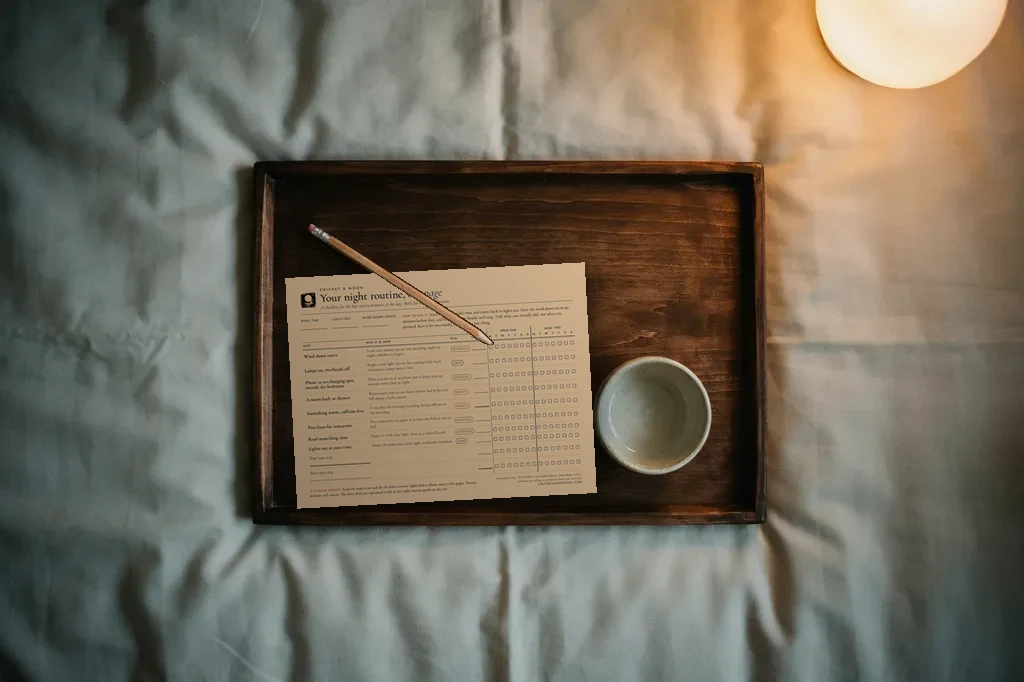
The printable checklist puts all of this on one landscape page: the eight steps with their reasons, a column for your own times, two blank rows for steps of your own, and a two-week tick grid. Every step is tagged with the dial it turns. You can read the whole list on the checklist page without signing up.
The last ninety minutes at a glance
Here is the shape of the evening for a 10:30 p.m. lights-out. Move every time by the same amount for your own.
- Close the day. Write two lines for tomorrow.Attention
- Warm bath or shower. Lamps on, overheads off. Phone to its spot.WarmthLightAttention
- Something warm and caffeine-free. A few slow stretches.Warmth
- Read something slow.Attention
- Lights out.Light
The order matters more than the minutes. Closing the day first gives the mind an hour to let go. Warm water an hour or more before bed gives the body time to shed the heat. Lower light from the middle of the block lets melatonin rise on time. Reading at the end gives the evening something quiet to land on.
The full timetable, the reasons for each slot, and a 20-minute version for late nights are in our guide to what to do before bed.
Light: lamps, screens and the phone
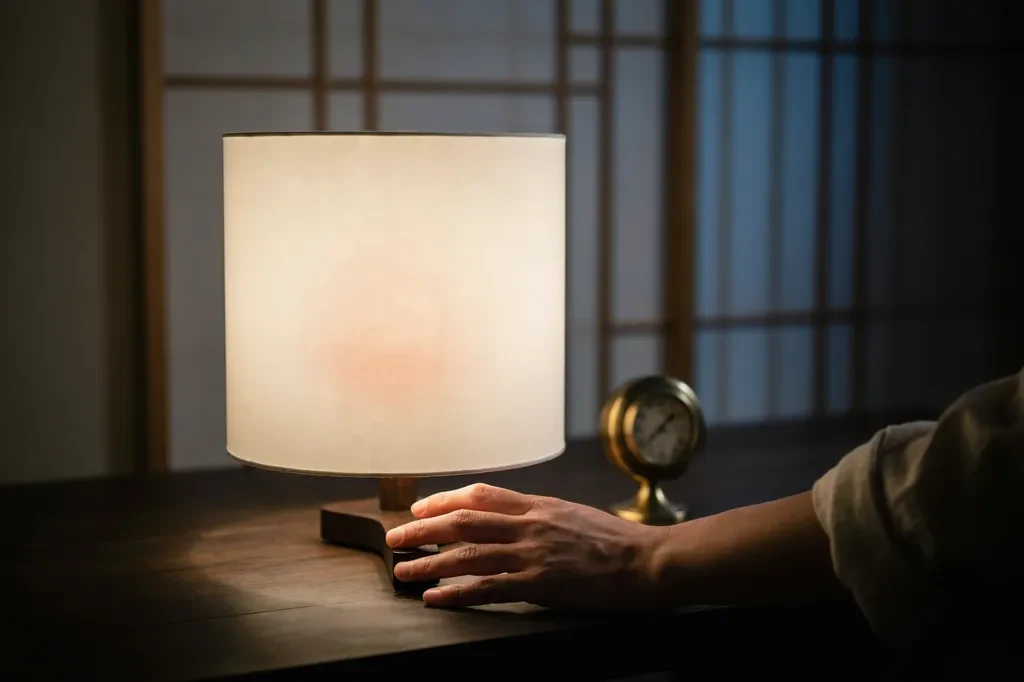
Lamps instead of overheads. The study above used ordinary room light below 200 lux and still found a large effect on melatonin timing in young adults. You do not need darkness, just less. Lamps at or below eye level, warm-toned bulbs and a few dark corners all help. A guide to dimming the lights covers bulbs and lamps in more detail.
The phone. The phone's blue light gets most of the attention, but the evidence points elsewhere. In a 2021 trial, 167 young adults used their phones at bedtime with Night Shift on, with it off, or not at all for a week. Sleep did not differ significantly between the three groups. A 2024 review in Sleep Medicine Reviews describes the link between screens and sleep as more complex than first thought, with light only one of several routes, alongside mental arousal and simply staying up later. That puts the phone on the attention dial more than the light one. The practical rule follows from that: the phone sleeps outside the bedroom, and goes to its spot when the wind-down starts. Our guide to putting the phone away before bed covers the research and what to do instead.
Morning light belongs here too. The body clock reads the whole day, and bright morning light helps evening sleepiness arrive on time. This matters most in winter, when days are short and evenings start in darkness. Our winter night routine covers the dark-season version.
Warmth: the bath, the drink, the cool room
A warm bath or shower. A 2019 meta-analysis found that water at 40 to 42.5°C (104 to 108.5°F), for as little as 10 minutes, one to two hours before bed, helped people fall asleep faster and was linked to better self-rated sleep. The timing is the part people get wrong. Straight from the bath to bed, the cooling has not happened yet. Our warm bath before bed guide covers the mechanism and a timing table.
Something warm to drink. A warm caffeine-free drink is less a sleep aid than a cue that the evening is ending. Chamomile, golden milk and the rest of our caffeine-free evening drinks all work. The caffeine part matters more than the drink. In a small 2013 study of 12 people, 400 mg of caffeine taken even six hours before bed disrupted sleep, so keep coffee to the morning and early afternoon.
A cool room. The Sleep Foundation suggests a bedroom of 65 to 68°F, about 18 to 20°C. Warm bedding in a cool room works better than a warm room. Our guide to the best bedroom temperature has the research behind it, and readers who run hot should start with why you sleep hot after 40.
Attention: closing the day, reading, slow movement
Close the day on paper. Before the wind-down proper, write two lines: what is unfinished, and when you will deal with it. It takes a minute and moves tomorrow out of your head. Our worry window is the longer version for people whose evenings fill with planning.
Read something slow. Books that are easy to put down work best: essays, poetry, nature writing, rereads. In a 2021 trial of 991 adults, people asked to read a book in bed for a week were more likely to say their sleep improved, 42 percent against 28 percent, though that was self-reported and people knew which group they were in. Our guide to books to read before bed has suggestions, including passages from our own library.
Slow movement or stillness. A few minutes of gentle stretching, a short bedtime yoga sequence, or a body scan lying down. Keep anything vigorous earlier in the evening. A 2019 meta-analysis of 23 studies found evening exercise generally did not harm sleep, but that vigorous exercise ending within an hour of bed might.
If thoughts keep racing. That is a different problem from an unclosed day, and it has its own tools. Start with how to stop overthinking at night and journaling before bed.
Night routines for real lives
The plan above assumes a free evening. Many evenings are not.
Parents. The last hour may not belong to you until the house is asleep, and a 90-minute block can feel absurd. Keep the light and the phone steps, and fit the rest where they land. A guide to night routines for parents goes into this.
No time. On late nights, do four things: write two lines for tomorrow, lamps on and overheads off, phone to its spot, ten minutes of reading. The simple night routine guide builds this into a routine of its own.
After work. Sometimes the problem starts at 6 p.m., not 10. If work follows you through the evening, the fix is a clear end to the workday, which our after-work routine covers.
Winter. Dark at half past four, a long evening, and a temptation to doze on the sofa. Morning light and a later, gentler dimming help. See the winter night routine.
Shift workers. The same three dials apply at a different hour. Our guide to sleep anchoring for shift workers covers the timing.
Keeping the routine going
Keep the wake time fixed. If you only keep one thing, keep this. A 2024 study that followed 60,977 UK adults with wrist monitors found that the people with the most regular sleep timing had a 20 to 48 percent lower risk of dying during follow-up than the least regular, and regularity predicted it better than sleep length did. That is an association in a large observational study, not proof that regularity causes better health, but it fits what is known about the body clock.
Plan for broken nights. A late dinner, a sick child, a party. Keep the wake time the next morning and do the 20-minute version that night. One broken night does not undo two good weeks.
Make it boring. The routines that last tend to be plain and repeatable. Elaborate evening rituals with candles, playlists and twelve steps photograph well and rarely survive a busy week. A guide to keeping a bedtime routine going covers keeping it going.
What a night routine cannot fix
A routine helps ordinary bad nights. It is not a treatment for a sleep disorder, and two patterns are worth taking to a clinician rather than to a checklist.
Insomnia that has settled in. Clinicians call it chronic insomnia when trouble falling or staying asleep happens at least three nights a week, for at least three months, and affects how you function in the day, despite having the chance to sleep. For that, the first treatment both the American College of Physicians and the American Academy of Sleep Medicine recommend is cognitive behavioral therapy for insomnia, CBT-I, rather than sleeping pills. It is a structured program that works on the habits and thoughts that keep insomnia going. Our guide to stimulus control explains one of its core parts.
Signs of sleep apnea. See a doctor if you, or someone who shares your bed, notice snoring loud enough to disturb sleep, pauses in your breathing, waking up gasping or choking, or heavy sleepiness in the day. Not everyone who snores has sleep apnea, but these signs are worth checking, and no evening routine will fix them.
Frequently asked questions
What is a good night routine for sleep? Lower the lights, put the phone away, have something warm and caffeine-free, close the day with a short note, and read something slow. Keep the same wake time and roughly the same lights-out every day.
How long should a night routine be? Sixty to ninety minutes suits most evenings, but there is no tested ideal. A 20-minute version on busy nights is far better than skipping it.
What should I do 30 minutes before bed? Read something slow in low light, with the phone already put away for the night.
What should a night routine not include? Work that needs decisions, late caffeine, vigorous exercise in the last hour, bright overhead light, and scrolling in bed.
Does a bedtime routine work for adults, or only for kids? The same parts work for adults: lower light, a cooler body, a quieter mind, and a regular time. The research above was done in adults.
How long does it take for a night routine to work? Give it two weeks before you judge it. Some changes, like dimmer evening light or a warm shower earlier, may help sooner.
The bottom line
A night routine is three dials turned down in the right order. Lower the light, let the body cool, and move your attention from the day to something quiet. Fix the wake time first, start the wind-down an hour or so before lights-out, and choose a few steps you will actually do. Download the checklist, run it for two weeks, and keep what helps. Expect a modest difference on most nights. On a bad week, a modest difference is a lot.
Sources
Retrieved November 2026.
- Gooley JJ, et al. J Clin Endocrinol Metab. 2011;96(3):E463-E472. doi:10.1210/jc.2010-2098 (title not retrieved)
- Duraccio KM, Zaugg KK, Blackburn RC, Jensen CD. Sleep Health. 2021;7(4):478-484. doi:10.1016/j.sleh.2021.03.005 (title not retrieved)
- Bauducco S, Pillion M, Bartel K, Reynolds C, Kahn M, Gradisar M. A bidirectional model of sleep and technology use. Sleep Med Rev. 2024;76:101933. doi:10.1016/j.smrv.2024.101933 (abstract)
- Haghayegh S, Khoshnevis S, Smolensky MH, Diller KR, Castriotta RJ. Before-bedtime passive body heating by warm shower or bath to improve sleep: a systematic review and meta-analysis. Sleep Med Rev. 2019;46:124-135. doi:10.1016/j.smrv.2019.04.008 (abstract)
- Drake C, Roehrs T, Shambroom J, Roth T. J Clin Sleep Med. 2013;9(11):1195-1200. doi:10.5664/jcsm.3170 (title not retrieved)
- Sleep Foundation. The Best Temperature for Sleep. sleepfoundation.org (°F range used; °C is our own conversion)
- Finucane E, et al. Does reading a book in bed make a difference to sleep? The People's Trial (full title not retrieved). Trials. 2021;22:873. doi:10.1186/s13063-021-05831-3
- Stutz J, Eiholzer R, Spengler CM. Sports Med. 2019;49(2):269-287. doi:10.1007/s40279-018-1015-0 (title not retrieved)
- American Academy of Sleep Medicine. Healthy Sleep Habits. sleepeducation.org
- Lally P, van Jaarsveld CHM, Potts HWW, Wardle J. How are habits formed. Eur J Soc Psychol. 2010. doi:10.1002/ejsp.674
- Windred DP, Burns AC, Lane JM, Saxena R, Rutter MK, Cain SW, Phillips AJK. Sleep. 2024;47(1). doi:10.1093/sleep/zsad253 (observational; title not retrieved)
- Qaseem A, Kansagara D, Forciea MA, Cooke M, Denberg TD, et al. Management of chronic insomnia disorder in adults: a clinical practice guideline from the American College of Physicians. Ann Intern Med. 2016;165(2):125-133. doi:10.7326/M15-2175
- American Academy of Sleep Medicine. Clinical practice guideline on chronic insomnia treatment. J Clin Sleep Med. 2021. doi:10.5664/jcsm.8986 (full title and authors not retrieved)
- Grima NA, Bei B, Mansfield D. Insomnia theory and assessment. Aust J Gen Pract. 2019;48(4). racgp.org.au
- Mayo Clinic. Obstructive sleep apnea: symptoms and causes. mayoclinic.org
Educational only. This article is not medical advice, and nothing in it is a substitute for talking to a clinician about your own sleep.