
Home / Journal / Stillness Practice
The Body Scan for Sleep
A racing mind needs somewhere else to go. Cognitive shuffling gives it a string of unrelated images. A worry window gives it a scheduled outlet. The body scan gives it something closer to hand: your own body, one small region at a time, until there is less left to spin on.
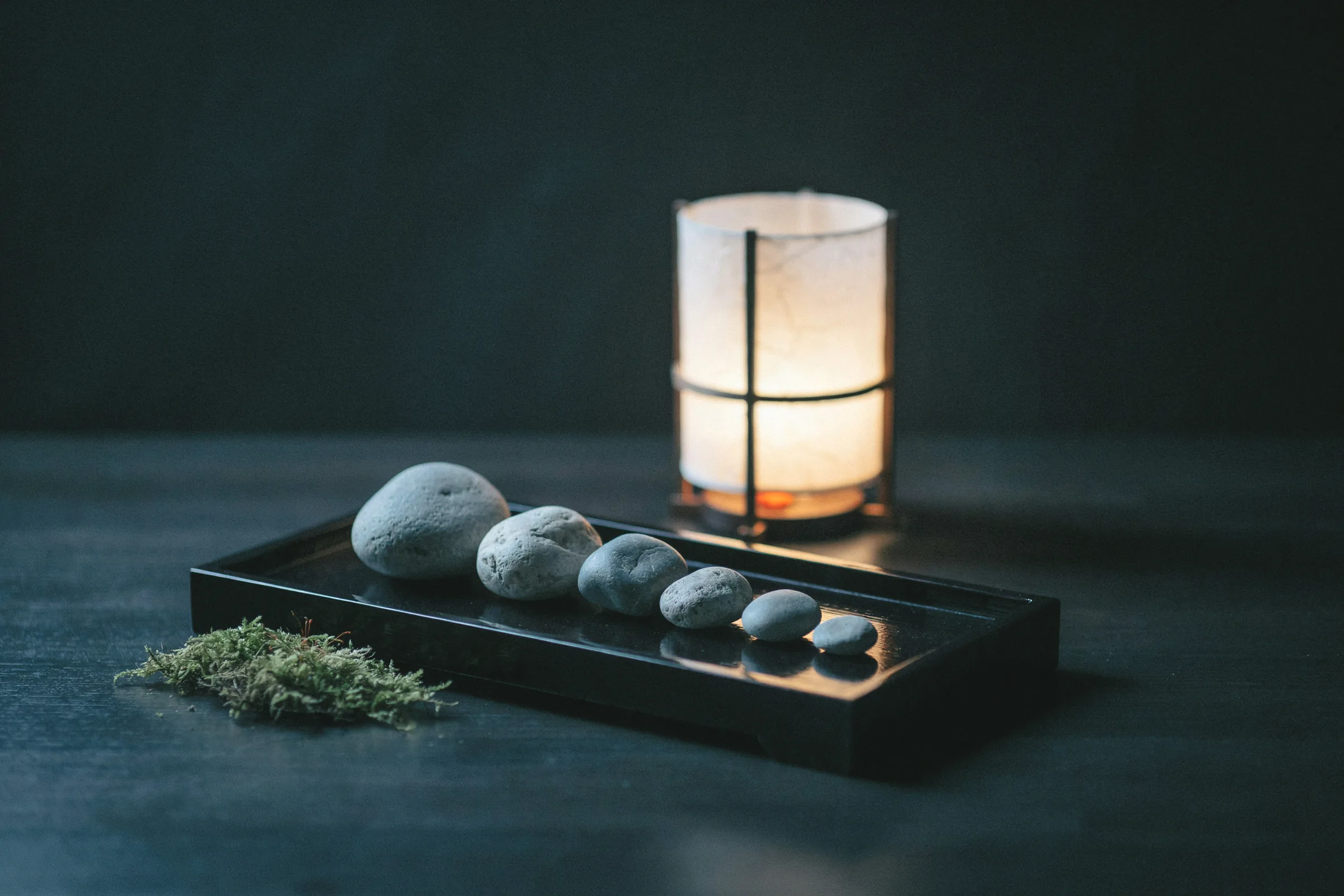
It is a mindfulness meditation, and it is simple enough to describe in a sentence. Lie down, close your eyes, and move your attention slowly through the body in sequence, noticing what is there without trying to change it.
How to Do It
Lie on your back with your arms at your sides and start at your feet. Notice whatever is there, warmth or pressure or tingling or nothing at all, without judging it and without trying to relax it on purpose. After a few breaths, move to the ankles, then the calves and knees, then the thighs, and work up through the hips, stomach and chest, then the hands, arms, shoulders, neck and face.
Go slowly enough that you are noticing and not ticking boxes. A scan can be short or long, and neither study below compared lengths. If your mind wanders, and it will, bring it back to the part of the body you were on. The coming back is the practice, not a lapse in it.
What the Evidence Shows
The evidence for a body scan on its own is thin. The two studies closest to the question each miss in a different way.
The first is a 2015 randomized trial in JAMA Internal Medicine. It enrolled 49 adults aged 55 and older, with a mean age of 66, who had moderate sleep disturbance, meaning a Pittsburgh Sleep Quality Index score above 5. Twenty-four were assigned to a six-week mindful awareness practices course and 25 to a six-week sleep hygiene education course. Both groups started near 10.2 on the index. The mindfulness group ended near 7.4 and the sleep hygiene group near 9.1. The between-group difference was 1.8 points, with a 95 percent confidence interval of 0.6 to 2.9 and an effect size of 0.89.
The interval is wide, so the real gap could be anywhere from about half a point to about three points. An effect size of 0.89 is large by the usual labels, but with 49 people it is a promising result and not a settled size. The authors list limits of their own. They had 12 percent dropout, a mostly female and well-educated sample, no objective sleep measures such as actigraphy, and participants who were cognitively intact with moderate disturbance rather than clinical insomnia. They say the findings need replication.
The other limit is the one that matters here. The paper describes the course as mindful sitting meditation, mindful eating, appreciation meditation, loving-kindness meditation, mindful walking and mindful movement. It does not mention a body scan. So the trial supports a mindfulness course, and it cannot tell you how much of the benefit, if any, came from scanning the body.
The second study looks at the body scan directly, with its own limits. In a 2020 paper in Mindfulness, de Bruin, Meijer and Bögels followed 54 adolescents through six weeks of internet-delivered cognitive behavioral therapy for insomnia. Twenty-six practiced a body scan and 28 did not. Both groups improved by moderate to large amounts. The body scan group also showed medium-sized improvements in time awake after falling asleep, in the feeling of sleeping too little, and in irritation, where the other group showed no significant change. The participants were not randomly assigned to the two groups, and the authors call for randomized trials.
That is a finding in teenagers, and teenagers are not the readers this page is written for. A result in 54 adolescents is not a result about a 55-year-old.
So the position is this. A mindfulness course helped older adults with moderate sleep problems more than sleep hygiene education did, in one small trial. A body scan was linked to extra gains in adolescents, in one study that was not randomized. We found no trial testing a body scan alone, in adults, for sleep. It is a reasonable thing to try, and it costs nothing, but the evidence does not yet say it works.
Why It Might Help
This part is reasoning, not a finding. A racing mind is attention with nowhere assigned to go, so it follows whatever thought is loudest. A body scan gives attention a slow, fixed route with nothing to solve at the end of it. It is a physical version of what cognitive shuffling does with images, so it may suit people whose racing thoughts feel more wired into the body than looped in words. It is also a gentler cousin of the problem described in why "just relax" makes insomnia worse, because the instruction is to notice, not to relax.
What to Expect
Falling asleep halfway through is a fine outcome. If you reach the end of the scan still awake, that is fine too. Some people start again from the feet, and others move to a different technique once there is nothing left to notice. You do not have to finish. If the thoughts that keep you awake are specific ones, how to stop overthinking at night sorts them by type.
The first few tries can feel oddly effortful. Pointing your attention on purpose is a small skill, and nothing we read says how quickly it settles.
Who Should Be Cautious
A body scan asks you to stay with physical sensation for a while, and for some people that makes things worse. A 2017 interview study in PLOS ONE documented difficult experiences in Buddhist meditators, including changes in sleep and in bodily sensation. The 60 practitioners were recruited because they had had such experiences, so the study cannot say how common they are.
If paying attention to your body tends to make you feel worse and not calmer, skip this one. Pain can be hard to sit with, and so can anything that stirs up difficult memories. If that is your situation, mention it to a clinician or therapist rather than pushing through alone. If you are still having trouble sleeping after you have tried a technique properly and consistently, stimulus control is the other one worth reading about.
Frequently Asked Questions
Do I have to do the whole scan every time? No. A shorter version from feet to head gives the mind a fixed task in place of open space.
What if I fall asleep before the end? That counts as it working. The scan does not have to be finished to be useful.
Is this the same as progressive muscle relaxation? They are different exercises. Progressive muscle relaxation has you tense and release each muscle group, while a body scan only observes each area.
How is it different from cognitive shuffling? Both give the mind a low-stakes assignment. Cognitive shuffling uses disconnected images and the body scan uses physical sensation. Which suits you is largely a matter of preference.
Bottom Line
The body scan is a free, low-risk way to give a busy mind a slow job to do. The evidence behind it is a small trial of a wider mindfulness course in older adults and one non-randomized study in adolescents. Try it as an experiment, and judge it by your own nights.
Sources
Retrieved 4 October 2026.
- Black DS, O'Reilly GA, Olmstead R, Breen EC, Irwin MR. "Mindfulness Meditation and Improvement in Sleep Quality and Daytime Impairment Among Older Adults With Sleep Disturbances: A Randomized Clinical Trial." JAMA Internal Medicine 175(4), 494-501 (2015). Read it
- de Bruin EJ, Meijer AM, Bögels SM. "The Contribution of a Body Scan Mindfulness Meditation to Effectiveness of Internet-Delivered CBT for Insomnia in Adolescents." Mindfulness (2020). Abstract only. Read it
- Lindahl JR, Fisher NE, Cooper DJ, Rosen RK, Britton WB. "The Varieties of Contemplative Experience: A mixed-methods study of meditation-related challenges in Western Buddhists." PLOS ONE (2017). Read it
Educational only. This article is not medical advice, and nothing in it is a substitute for talking to a clinician about your own sleep.