Home / Journal / Stillness Practice
Stimulus Control: Why You Should Get Out of Bed
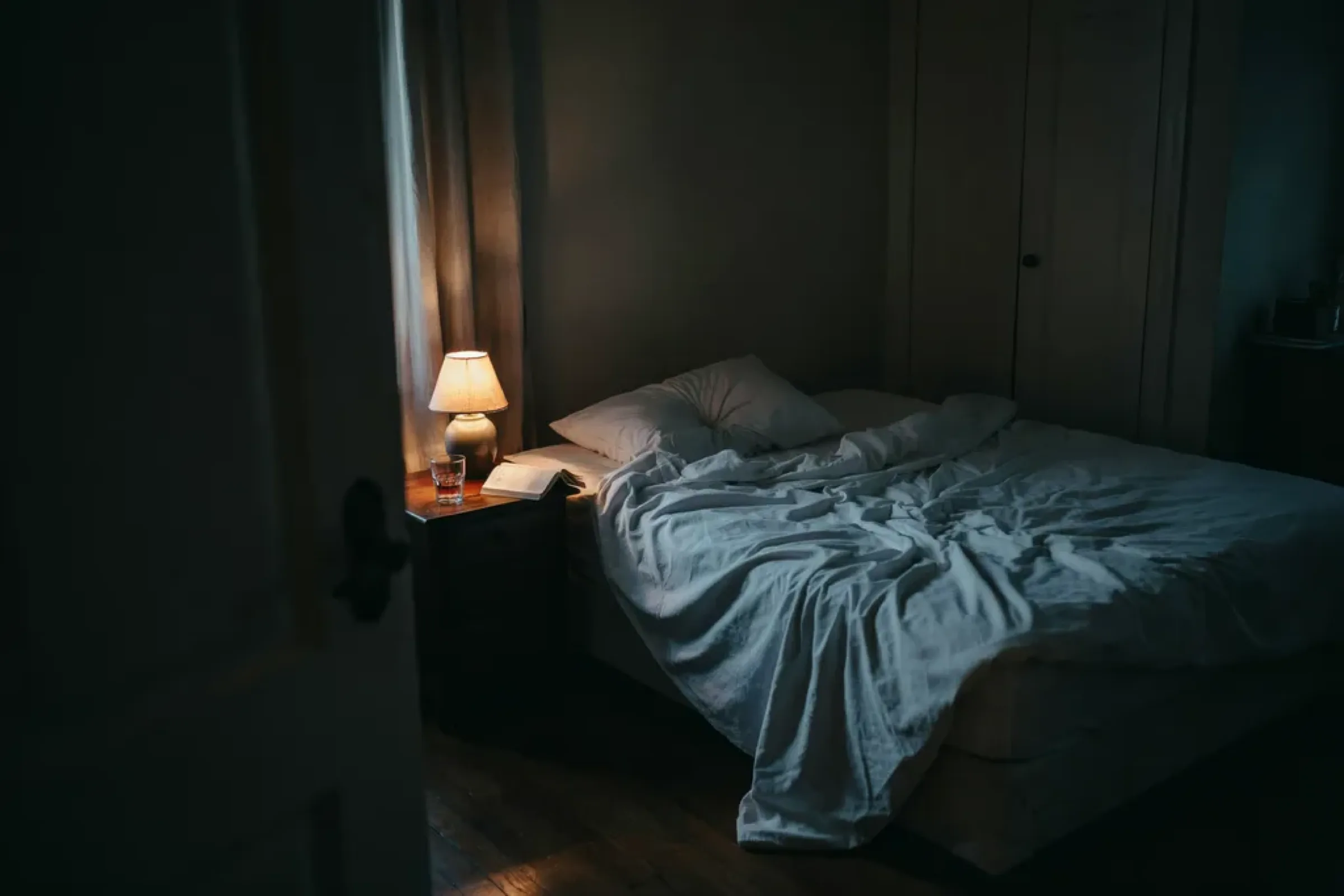
The instruction sounds wrong the first time you hear it. You are lying awake, frustrated, unable to sleep, and the advice is to get up. Leave the bed, sit somewhere else until you feel sleepy, then try again.
It is less strange than it sounds. Stimulus control is one of the behavioral treatments for insomnia, and it rests on a single idea: a bed can quietly stop meaning "sleep" and start meaning "the place where I lie awake and get frustrated."
Where It Came From
The psychologist Richard Bootzin described it in 1972, in a short paper from Northwestern University. The paper reports one case. A 25-year-old man had struggled to fall asleep for four or five years. He lay awake worrying about money and his job until three or four in the morning, then turned on the television to stop the worrying.
Bootzin's reasoning was that bedtime had become a cue for activities that compete with sleep, so the treatment pulled the two apart. If the man wanted to worry or watch television, he had to do it somewhere other than the bedroom. Within two weeks, by Bootzin's account, the picture had changed, and the man reported sleeping two to four hours more a night than before. Bootzin also wrote that a single case cannot rule out other explanations. He was right to say so, and it is why the later trials matter more than the story.
The Problem It Is Solving
The theory goes like this. Every night spent tossing, worrying or checking the clock in bed is a small lesson to the brain: this is where wakefulness happens. After enough nights, getting into bed starts to cue alertness instead of drowsiness, even when you are tired. The same conditioning idea sits behind why clock-watching makes insomnia worse.
That is a theory about why the treatment might work. The trials below test whether it does.
The Instructions
Bootzin's 1972 version had four rules and no time limit. A footnote explains why. He wrote that any attempt to be more specific would have produced clock-watching, which would have made the problem worse. Later protocols are longer. The version below combines Bootzin's rules with the American Academy of Sleep Medicine's description of the treatment and a clinical guide for general practitioners from the Royal Australian College of General Practitioners.
- Go to bed only when you are sleepy.
- Keep the bed for sleep. No reading and no television in bed. The AASM lists sleep and sex as the only two uses.
- If you are not asleep after about 15 to 20 minutes, get up and go to another room.
- Do something quiet and relaxing there, and go back to bed when you feel sleepy.
- If you still cannot sleep, repeat. Bootzin's rule was to do this as often as necessary through the night.
- Get up at the same time every morning, weekends included, however the night went.
The 15 to 20 minutes is a rough gauge, not a countdown. Bootzin left it vague on purpose, so estimate it. A treatment that has you watching the clock has defeated itself.
What the Evidence Shows
A 2024 systematic review and meta-analysis in the Journal of Sleep Research pooled 11 trials of stimulus control in adults, most published between 1978 and 1998. (We read the abstract, not the full paper.) It measured three things from sleep diaries: awakenings, sleep onset latency, which is how long it takes to fall asleep, and total sleep time.
Against passive comparison groups, stimulus control improved sleep onset latency and total sleep time by a Hedges g of 0.38 to 0.85. Against active comparison treatments, the improvement was negligible, a g of 0.06 to 0.30.
By the usual rough labels, 0.38 is a small to moderate difference and 0.85 is a large one. In plain terms, stimulus control did better than doing nothing, by an amount that ran from modest to large depending on the trial and the measure. It did about as well as the other treatments it was set against, not better than them. The abstract does not say which number belongs to which outcome. The authors also note methodological uncertainties in the trials and say more robust studies are needed before stronger conclusions are possible.
That is a respectable result from an old and fairly small body of trials. It is not a miracle cure.
The American Academy of Sleep Medicine's 2021 guideline suggests stimulus control as a single treatment for chronic insomnia in adults and grades that recommendation conditional, its weaker grade. Its strong recommendation goes to multicomponent cognitive behavioral therapy for insomnia, which combines several techniques.
Why It Feels Wrong at 2 A.M.
Getting up in the middle of the night can feel like giving up on sleep. In Bootzin's case report, the man had to leave the bed four or five times a night at the start. Treat that as one man's account and not a forecast of your first week.
Who Should Be Cautious
In a 2011 chapter, Bootzin and Perlis note that the instructions may need changing for people who cannot easily get out of bed without help, people at risk of slips and falls, and people who cannot follow them because of dementia. They also write that there is no evidence showing where the therapy is contraindicated.
A dark house at night carries its own risks. Plan the route and the place you will sit before you need them, not at 2 a.m. If you have another sleep disorder or a medical condition, ask a clinician before you change how you handle the night.
How It Fits With the Rest of This Cluster
Once you are up, thoughts are often what keep you awake, and how to stop overthinking at night sorts them into types that each have a different fix. Why "just relax" makes insomnia worse covers the trouble with trying to relax on command, which is part of why leaving the bed can feel better than staying in it.
Frequently Asked Questions
Does stimulus control really mean getting out of bed every time? That is the instruction. Staying in bed awake and frustrated is the exact pattern the treatment is built to interrupt.
Is the 20-minute mark exact? No. Bootzin deliberately gave no number, and the clinical guide we read says 15 to 20 minutes. Use a rough sense of "this is not happening" and leave the clock alone.
What should I do once I am up? Something quiet and relaxing, in another room. Bootzin's rules already put the television out of the bedroom, and the same logic applies to anything that keeps you switched on.
How long before it works? We could not find a reliable figure, so we will not give one. The trials report results after treatment and at follow-up, not a day count.
Does the same rule apply when I wake at 3 a.m.? Yes. Bootzin's rules say to repeat the getting up as often as necessary through the night.
Bottom Line
Stimulus control asks you to protect the meaning of the bed by leaving it when it has stopped meaning sleep. The evidence is better than nothing and about as good as comparable treatments, from trials that are mostly decades old. It is worth a real try, with the fall risk planned for.
Sources
Retrieved 4 October 2026.
- Jansson-Fröjmark M, Nordenstam L, Alfonsson S, Bohman B, Rozental A, Norell-Clarke A. "Stimulus control for insomnia: A systematic review and meta-analysis." Journal of Sleep Research 33(1), e14002 (2024). Abstract only. PubMed
- Bootzin RR. "Stimulus Control Treatment for Insomnia." Proceedings of the 80th Annual Convention of the American Psychological Association (1972), 395-396. Read it
- Bootzin RR, Perlis ML. "Stimulus Control Therapy." In Behavioral Treatments for Sleep Disorders (Elsevier, 2011). First page only: indications and contraindications. Read it
- Edinger JD, Arnedt JT, Bertisch SM, et al. "Behavioral and psychological treatments for chronic insomnia disorder in adults: an American Academy of Sleep Medicine clinical practice guideline." Journal of Clinical Sleep Medicine 17(2), 255-262 (2021). Read it
- Edinger JD, et al. "Behavioral and psychological treatments for chronic insomnia disorder in adults: an American Academy of Sleep Medicine systematic review, meta-analysis, and GRADE assessment." Journal of Clinical Sleep Medicine 17(2), 263-298 (2021). Used for the description of the treatment in its Table 1. Read it
- Royal Australian College of General Practitioners. "GP guide to behavioural therapy for insomnia." Read it
Educational only. This article is not medical advice, and nothing in it is a substitute for talking to a clinician about your own sleep.