
Home / Journal / Stillness Practice
Why Clock-Watching Makes Insomnia Worse (and What to Do Instead)
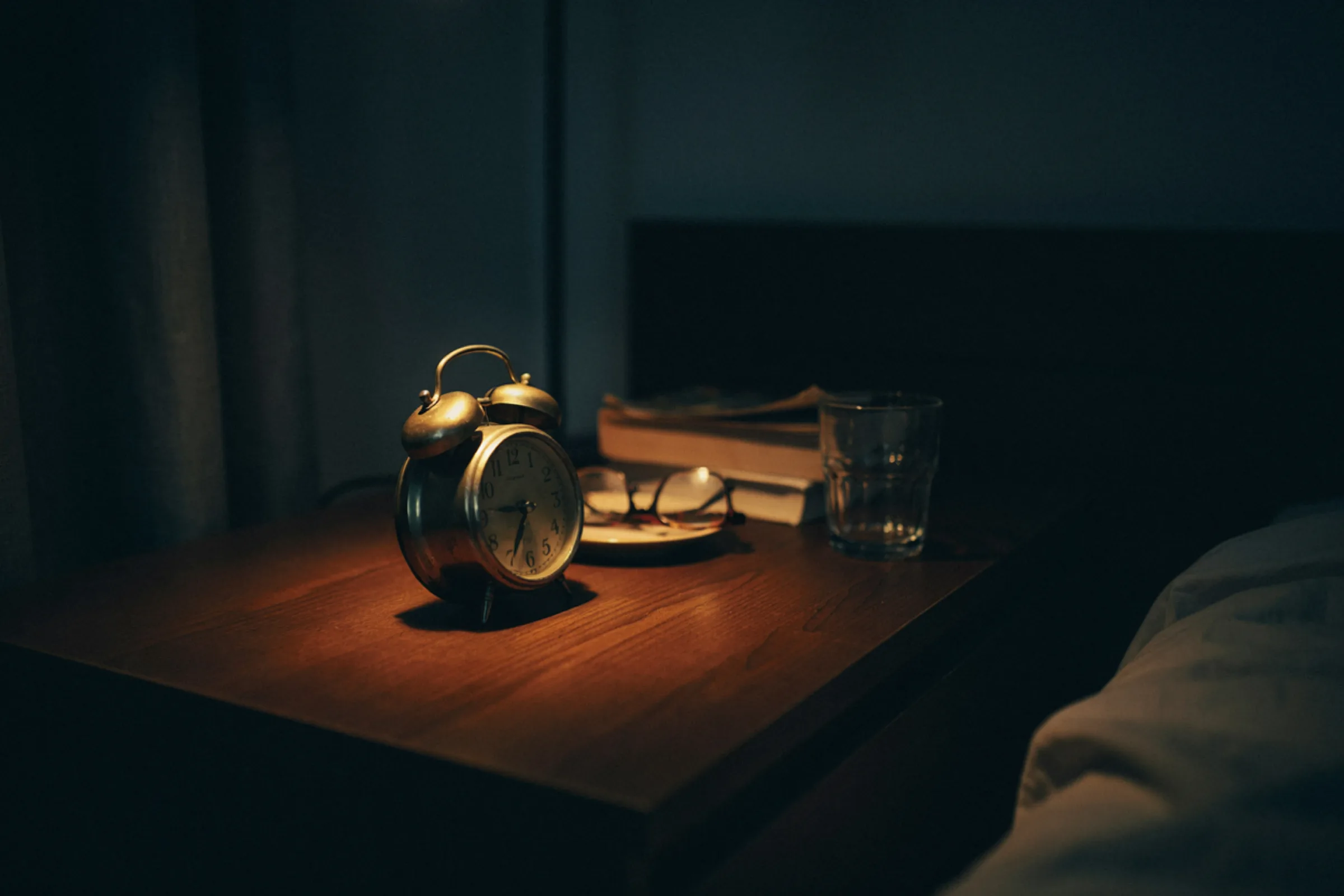
Two in the morning. Awake for reasons that aren't entirely clear, the hand reaches for the phone or turns toward the nightstand clock. The math starts immediately: if sleep comes right now, that's still five hours. Four and a half. Four. Each check feels like gathering useful information. It functions as something closer to the opposite, a small, repeated ritual that trains the brain to treat the bed as a place for checking and worrying rather than a place for sleep.
What Clock-Watching Actually Does to Sleep
The false sense of control is the first problem. Knowing the exact number of hours left feels like it should help, but it mostly supplies material for time-pressure math, the kind of countdown thinking that activates the same stress response as a real deadline. That stress response is directly incompatible with falling back asleep.
The second, quieter problem is conditioning. Sleep researchers describe this as conditioned arousal: repeated pairing of the bed with an activity, worrying, checking, calculating, gradually teaches the brain to treat the bed itself as a cue for that activity, the same way Pavlov's dogs learned to associate a bell with food. A bed checked and recalculated on night after night starts to function as a trigger for exactly that behavior, rather than for sleep.
How This Connects to Insomnia More Broadly
Conditioned arousal is one of the central mechanisms behind chronic insomnia, and it's the specific target of stimulus control therapy, developed by psychologist Richard Bootzin at the University of Arizona. Stimulus control works by deliberately re-pairing the bed with sleep and removing everything else, no reading, no phone, no clock-checking, so the bed and bedroom stop functioning as cues for wakefulness. Clock-watching sits squarely inside the list of behaviors stimulus control protocols ask people to give up, alongside phone use and other in-bed activities that compete with sleep.
An occasional glance at the clock during a rough night isn't the concern here. The pattern that causes trouble is the repeated, nightly habit, checking, calculating, checking again, that turns a bedroom into a small stress-monitoring station instead of a place associated with rest.
What to Do Instead
Turn the clock face away, or remove it from the nightstand entirely. If a clock is needed for a morning alarm, one that doesn't display the time at a glance, or one positioned across the room, removes the temptation to check without removing the alarm function.
Get the phone out of reach, not just face-down. Face-down on the nightstand is still within arm's reach, which means still within temptation's reach during a 2 a.m. wake-up.
Replace the checking impulse with a neutral action. Rather than reaching for a device, try a technique built for exactly this kind of moment, cognitive shuffling is a reasonable option, since it gives the mind something to do that isn't time-math.
If you genuinely need to know the time, set one alarm and trust it. A single, reliable alarm removes the reason to keep checking throughout the night. The goal isn't ignorance of the time, it's breaking the habit of repeated verification.
How Long the Habit Takes to Break
The urge to check doesn't disappear the first night the clock gets turned around. Stimulus control protocols generally note that the first week or two can feel harder than before, since removing a familiar (if unhelpful) habit initially increases the felt need for it. Most people who stick with stimulus control instructions notice improvement within two to four weeks, according to sleep-medicine clinical guidance, with the anxious anticipation around bedtime easing first, ahead of full sleep quality gains.
Frequently Asked Questions
Is it bad to check the clock even once during the night? No. An occasional glance isn't the problem. The issue is repeated checking that turns into time-pressure math and rumination.
Why does knowing the time make it harder to fall back asleep? Calculating remaining sleep time activates a stress and urgency response, similar to a work deadline, which works directly against the calm, low-arousal state needed to fall back asleep.
Should I turn my phone off completely at night? Not necessarily. Turning the screen away and moving the phone out of arm's reach removes the temptation to check without requiring a full power-down.
What if I need the clock for an early shift or appointment? Set one alarm and trust it, rather than periodically checking how much time remains. A single alarm removes the reason to keep checking throughout the night.
Is this the same thing as stimulus control therapy? Related but narrower. Stimulus control addresses the bed-sleep association broadly, including rules like getting up if you can't sleep and reserving the bed for sleep only, while removing the clock addresses one specific trigger within that larger framework.
Bottom Line
Clock-watching feels like useful information-gathering and functions like a habit that keeps training the bed to mean stress instead of rest. The fix is almost entirely environmental: move the clock, move the phone, trust a single alarm, and give the checking impulse somewhere else to go. It's a small change with an outsized effect, mostly because it interrupts a pattern that would otherwise reinforce itself every single night.
Sources
- Bootzin, R.R. "Stimulus Control Treatment for Insomnia." Proceedings of the American Psychological Association 7 (1972): 395-396.
- Bootzin, R.R., Epstein, D., Wood, J.M. "Stimulus Control Instructions." In Case Studies in Insomnia, edited by P.J. Hauri, 19-28. Springer US, 1991. Read it