Home / Journal / The Evening Hour
What to Do Before Bed: An Hour-by-Hour Plan for the Last Ninety Minutes
In the last 90 minutes before bed, bring the light down, let your body cool, and move from doing things to winding down, roughly in that order. The order matters because each step sets up the next one. Light that falls early lets melatonin rise on time. Warm water an hour or so out gives the body time to shed heat. A quiet half hour at the end has something to land on.
In this piece
Most lists of things to do before bed give you the steps and leave the timing to you. This one gives you a timetable, a reason for every slot, and a 20-minute version for the nights you do not have 90. Treat the times as a pattern to slide, not a rule. Count back from your own lights-out and the rest follows.
Work backwards from lights-out
Start from your wake time, since that is where most sleep advice begins. The American Academy of Sleep Medicine's advice is to get up at the same time every day, weekends included. Count back the sleep you need and you have lights-out. Everything below counts back from there.
Here is the plan for a 10:30 p.m. lights-out:
- Close the day. Write two lines for tomorrow.Attention
- Warm bath or shower. Lamps on, overheads off. Phone to its spot.WarmthLightAttention
- Something warm and caffeine-free. A few slow stretches.Warmth
- Read something slow.Attention
- Lights out.Light
Slide every row by the same amount if your lights-out is earlier or later.
90 minutes out: close the day
Finish anything that needs a decision. Answer the message, set out tomorrow's bag, shut the laptop. Then write two lines on paper: what is unfinished and when you will deal with it. Getting tomorrow out of your head is the idea behind our worry window, and doing it now, not at 10:25 in bed, gives the mind an hour to let go.
This is also the last sensible point for hard exercise. A 2019 meta-analysis of 23 studies found that evening exercise generally did not harm sleep, but that falling asleep and sleeping well might be impaired after vigorous exercise ending within an hour of bedtime. A walk is fine. A sprint session is better earlier.
75 to 60 minutes out: warm water, lower light
Warm water. A warm bath or shower now, not right before bed. A 2019 meta-analysis found that water at 40 to 42.5°C (104 to 108.5°F), for as little as 10 minutes, one to two hours before bed, helped people fall asleep faster. The heat you shed afterwards is what does it. Our guide to the warm bath before bed covers the mechanism.
Lamps on, overheads off. In a 2011 study of 116 healthy adults aged 18 to 30, ordinary room light below 200 lux in the hours before bed delayed melatonin onset in almost everyone and shortened the night's melatonin by about 90 minutes compared with dim light. Lamps, warm bulbs and a few dark corners keep the evening closer to dim.
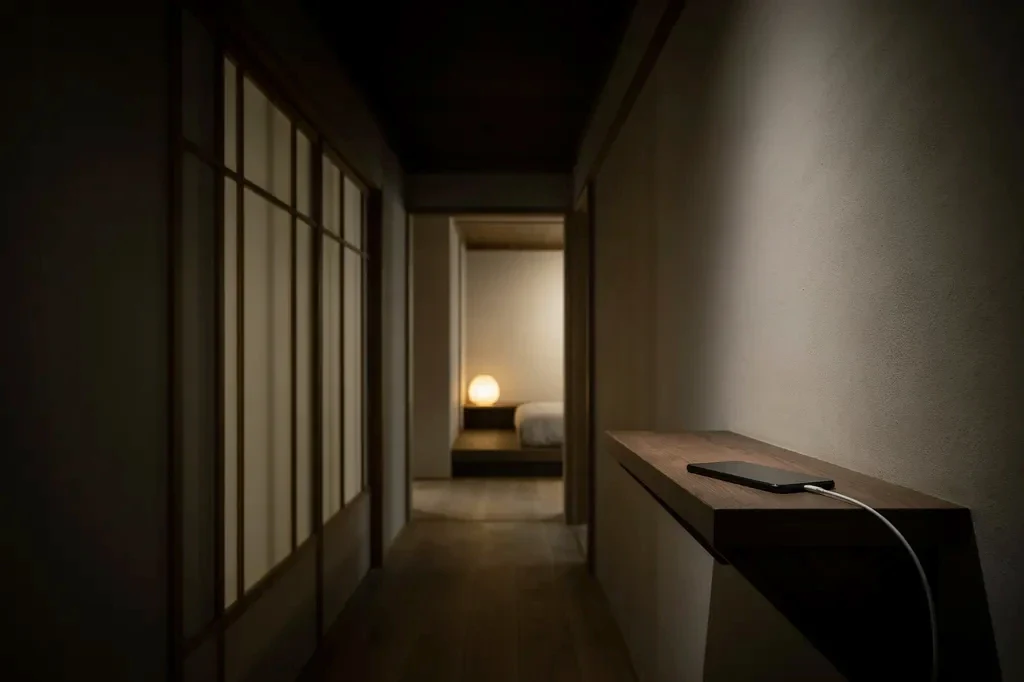
The phone goes to its charging spot. Outside the bedroom if you can manage it. Our piece on putting the phone away before bed explains why this matters more for your bedtime than for the screen's light.
45 minutes out: something warm and slow
Make a warm caffeine-free drink. Our list of caffeine-free evening drinks has options. The caffeine question is earlier than most people think. In a small 2013 study, 12 people took 400 mg of caffeine at bedtime, three hours before, or six hours before. Even at six hours, it disrupted their sleep. Total sleep fell by about 41 minutes, though that figure fell just short of statistical significance. Keep coffee to the morning and early afternoon.
Then a few slow stretches, or a body scan if you prefer to lie down. Lay out tomorrow's clothes while you are up.
30 minutes out: read
Something slow, on paper or a dim e-ink screen. Our guide to books to read before bed has suggestions. If you struggle with insomnia, read in a chair rather than in bed, and go to bed when you feel sleepy rather than when the clock says so.
Lights-out, and if sleep does not come
Lights off at your time, close to the same time each night. A 2024 study that tracked 60,977 UK adults with wrist monitors found that people with the most regular sleep had a 20 to 48 percent lower risk of dying during follow-up than the least regular, and regularity predicted it better than how long they slept. That is an association, not proof that regularity is the cause, but it fits everything else known about the body clock.
If you are still awake after what feels like about 20 minutes, get up, go somewhere dim, and come back when you are sleepy. That is standard advice from sleep clinics, and our guides to stimulus control and clock-watching explain why it works.
The 20-minute version
Some nights there is no 90 minutes. Do this instead:
- Write two lines for tomorrow.
- Lamps on, overheads off.
- Phone to its charging spot.
- Read for ten minutes.
If you must drop something, drop the bath and the drink, and keep the light and the phone.
Adjusting the timetable
Night owls and early risers. Shift the whole block. Keep the order.
Shift workers. The same steps apply at a different hour. Our guide to sleep anchoring for shift workers covers the timing.
Parents. The last hour may not be yours until the house is asleep. Our guide to night routines for parents deals with that.
For the full picture of why these steps work, and how to build your own version, see our night routine guide and the printable checklist.
Frequently asked questions
What should I do in the hour before bed? Lower the lights, put the phone away, take a warm shower or bath if you like, have something warm and caffeine-free, and read something slow.
How long before bed should I start winding down? Sixty to ninety minutes suits most evenings. There is no tested ideal. Twenty minutes is far better than none.
Should I shower before bed or in the morning for sleep? For sleep, a warm shower or bath one to two hours before bed is the better-supported choice. In a 2019 meta-analysis it helped people fall asleep faster.
What should I not do before bed? Avoid caffeine from early afternoon, vigorous exercise in the last hour, bright overhead light, and anything that needs a decision.
Is it bad to go to bed at different times? Regular sleep timing is linked to better health in large studies. Aim for roughly the same lights-out and the same wake time every day, weekends included.
The bottom line
The last 90 minutes have a shape: close the day, warm water and lower light, something warm and slow, a book, lights out. You do not have to follow the times to the minute. Keep the order, keep the wake time fixed, and on short nights do the 20-minute version.
Sources
Retrieved November 2026.
- American Academy of Sleep Medicine. Healthy Sleep Habits. sleepeducation.org
- Stutz J, Eiholzer R, Spengler CM. Sports Med. 2019;49(2):269-287. doi:10.1007/s40279-018-1015-0 (meta-analysis of 23 studies; title not retrieved)
- Haghayegh S, Khoshnevis S, Smolensky MH, Diller KR, Castriotta RJ. Before-bedtime passive body heating by warm shower or bath to improve sleep: a systematic review and meta-analysis. Sleep Med Rev. 2019;46:124-135. doi:10.1016/j.smrv.2019.04.008 (abstract)
- Gooley JJ, et al. J Clin Endocrinol Metab. 2011;96(3):E463-E472. doi:10.1210/jc.2010-2098 (title not retrieved)
- Drake C, Roehrs T, Shambroom J, Roth T. J Clin Sleep Med. 2013;9(11):1195-1200. doi:10.5664/jcsm.3170 (title not retrieved)
- Windred DP, Burns AC, Lane JM, Saxena R, Rutter MK, Cain SW, Phillips AJK. Sleep. 2024;47(1). doi:10.1093/sleep/zsad253 (observational, UK Biobank; title not retrieved)
- American Academy of Sleep Medicine. Brief Behavioral Treatment for Insomnia, provider fact sheet. 2025. aasm.org
Educational only. This article is not medical advice, and nothing in it is a substitute for talking to a clinician about your own sleep.