Home / Journal / The Evening Hour
The Printable Night Routine Checklist (and How to Make It Yours)
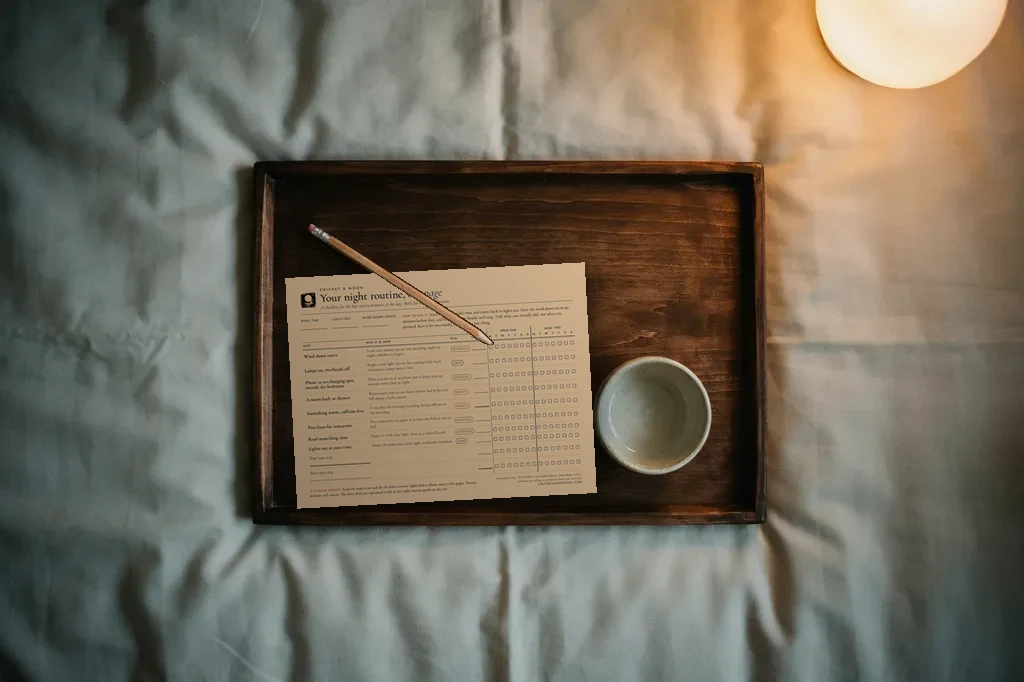
This is a free, one-page night routine checklist built to help you sleep. Eight steps, each with a reason, a column for your own times, and a two-week tick grid. Print it, fill it in, and keep it by the bed.
In this piece
Most night routine checklists mix skincare, productivity and sleep into one long list. Nothing on them is really about sleep, and the list is too long to keep. This one leaves all of that out.
Download the checklist
The page is landscape, prints on one sheet, and works in black and white. If you would rather not give an email address, the full list is below. Copy it onto any piece of paper and it does the same job.
What is on the checklist, and why each step is there
Each step turns one of three dials the evening controls: light, warmth or attention. Our night routine guide explains the three in full.
- Wind-down starts. A set start means you are not deciding, night by night, whether to begin. Attention.
- Lamps on, overheads off. In a 2011 study of 116 adults aged 18 to 30, ordinary room light in the hours before bed shortened the night's melatonin by about 90 minutes compared with dim light. Lamps keep it low. Light.
- Phone to its charging spot, outside the bedroom. Researchers now think what you do on the phone, and how late it keeps you up, matters more than its light. Our guide to putting the phone away before bed has the detail. Attention.
- A warm bath or shower. Water at 40 to 42.5°C (104 to 108.5°F), one to two hours before bed, helped people fall asleep faster in a 2019 meta-analysis. See warm bath before bed. Warmth.
- Something warm and caffeine-free. A cue that the evening is ending. In a small 2013 study, 400 mg of caffeine taken even six hours before bed disrupted sleep, so keep coffee to the morning. Ideas in our caffeine-free evening drinks. Warmth.
- Two lines for tomorrow. Puts tomorrow on paper so it does not follow you to bed. The worry window is the longer version. Attention.
- Read something slow. Paper or e-ink, low light. Stop at a natural break. Suggestions in books to read before bed. Attention.
- Lights out at your time. About the same time each night, weekends included, as the American Academy of Sleep Medicine advises. Light.
There are two blank rows at the bottom for steps of your own.
How to fill in the time column
Start from your wake time and count back the sleep you need. That is your lights-out. Then count back another 60 to 90 minutes for the wind-down start, and fill in the times between.
For a 6:30 a.m. wake and eight hours in bed:
| Step | Time |
|---|---|
| Wind-down starts | 9:00 p.m. |
| Lamps on, phone parked, warm water | 9:15 to 9:30 p.m. |
| Something warm | 9:45 p.m. |
| Read | 10:00 p.m. |
| Lights out | 10:30 p.m. |
Our what to do before bed guide explains why the steps sit in that order.
The two-week grid
Tick what you did, not what you planned. Some nights you will do three steps, and three still count.
Two weeks is a trial, not a habit. In the best-known study of habit formation, the time volunteers took to make a new behavior automatic ranged from 18 to 254 days, with a median of about two months. Two weeks is long enough to see whether the routine is helping and short enough to finish.
After week one, look at the grid. If nothing has changed, change one step rather than five. If a step never gets ticked, it probably does not fit your evening, so swap it for one of your own.
What the checklist leaves out on purpose
No skincare, no journaling prompts, no gratitude list, no tomorrow's-goals planner. Some of those are worth doing. They are just not about sleep, and every extra line makes the list harder to keep.
Frequently asked questions
What should be on a night routine checklist? A set wind-down time, lower lights, the phone parked outside the bedroom, a warm caffeine-free drink, a short note for tomorrow, something slow to read, and a regular lights-out.
How long should a night routine take? Sixty to ninety minutes suits most evenings, but there is no tested ideal. On busy nights, twenty minutes of the most important steps is far better than none.
Is a sleep hygiene checklist the same thing? Close. Sleep hygiene covers the whole day, from morning light to caffeine timing. A night routine checklist covers only the last part of the evening.
Do I have to do every step every night? No. Tick what you did. A routine kept most nights still works better than none.
How long until a night routine works? Give it two weeks before you judge it. Some changes, like dimmer evening light, may help sooner.
The bottom line
A night routine checklist works when it is short, built for sleep, and kept by the bed. Download the page, set your times, and tick it for two weeks. Then keep what helped and change one thing.
Sources
Retrieved November 2026.
- Gooley JJ, et al. J Clin Endocrinol Metab. 2011;96(3):E463-E472. doi:10.1210/jc.2010-2098 (title not retrieved)
- Bauducco S, Pillion M, Bartel K, Reynolds C, Kahn M, Gradisar M. A bidirectional model of sleep and technology use. Sleep Med Rev. 2024;76:101933. doi:10.1016/j.smrv.2024.101933 (abstract)
- Haghayegh S, Khoshnevis S, Smolensky MH, Diller KR, Castriotta RJ. Before-bedtime passive body heating by warm shower or bath to improve sleep: a systematic review and meta-analysis. Sleep Med Rev. 2019;46:124-135. doi:10.1016/j.smrv.2019.04.008 (abstract)
- Drake C, Roehrs T, Shambroom J, Roth T. J Clin Sleep Med. 2013;9(11):1195-1200. doi:10.5664/jcsm.3170 (title not retrieved)
- American Academy of Sleep Medicine. Healthy Sleep Habits. sleepeducation.org
- Lally P, van Jaarsveld CHM, Potts HWW, Wardle J. How are habits formed. Eur J Soc Psychol. 2010. doi:10.1002/ejsp.674
Educational only. This article is not medical advice, and nothing in it is a substitute for talking to a clinician about your own sleep.