Home / Journal / The Evening Hour
No Phone Before Bed? What the Evidence Actually Says
Your phone probably costs you sleep less through its blue light than through what you do on it and how late it keeps you up. The light effect is real in the lab. In everyday use, researchers now think the scrolling and the later lights-out matter more.
In this piece
That changes the advice. The usual rule, no screens for an hour before bed, is hard to keep and aims at the smaller problem. A simpler rule works better: the phone sleeps outside the bedroom. This guide covers what the research shows, why the one-hour ban fails for most people, and what to do with your hands instead.
What the research shows about phones and sleep
The light. In a small 2015 lab study, adults who read on a light-emitting e-reader in the evening had their melatonin suppressed by about 55 percent and took nearly 10 minutes longer to fall asleep than when they read a printed book. That is a real effect, measured carefully in a lab with a bright screen held close for several evenings.
The filter. If light were the main problem, night mode should fix it. In a 2021 study, 167 young adults aged 18 to 24 were randomly assigned for a week to use their phone at bedtime with Night Shift on, with it off, or not to use a phone at all. There were no significant differences in sleep between the three groups. In a later look at the data, people who already averaged more than about 6.8 hours of sleep slept best with no phone at all.
Everything else. A 2024 review in Sleep Medicine Reviews lays out four ways technology can affect sleep: bright light, mental arousal, being woken in the night, and simply staying up later. The authors call the link more complex than first thought, and note that it runs both ways. People who sleep badly also reach for their phones. In a survey of 844 Flemish adults, sending texts or taking calls after lights out was linked to taking longer to fall asleep, sleeping less efficiently and more insomnia symptoms.
Put plainly: the screen's light is one factor among several, and probably not the biggest one.
Why "no screens an hour before bed" rarely sticks
The rule removes the easiest thing to do in the evening and puts nothing in its place. For a lot of people the phone at night is how they talk to friends, follow a story or switch off after work. Take it away with no replacement and the evening has a hole in it, and the phone usually comes back to fill it.
The rule also treats all screens as the same. They are not. In the US National Sleep Foundation's 2011 poll of 1,508 Americans aged 13 to 64, nine in ten used some kind of device in the hour before bed. More use of interactive devices, phones, laptops and games, was linked to more trouble falling asleep and less refreshing sleep. Passive screens like television did not show that link. A familiar show across the room is a different thing from a feed held a foot from your face.
A simpler rule: the phone sleeps outside the bedroom
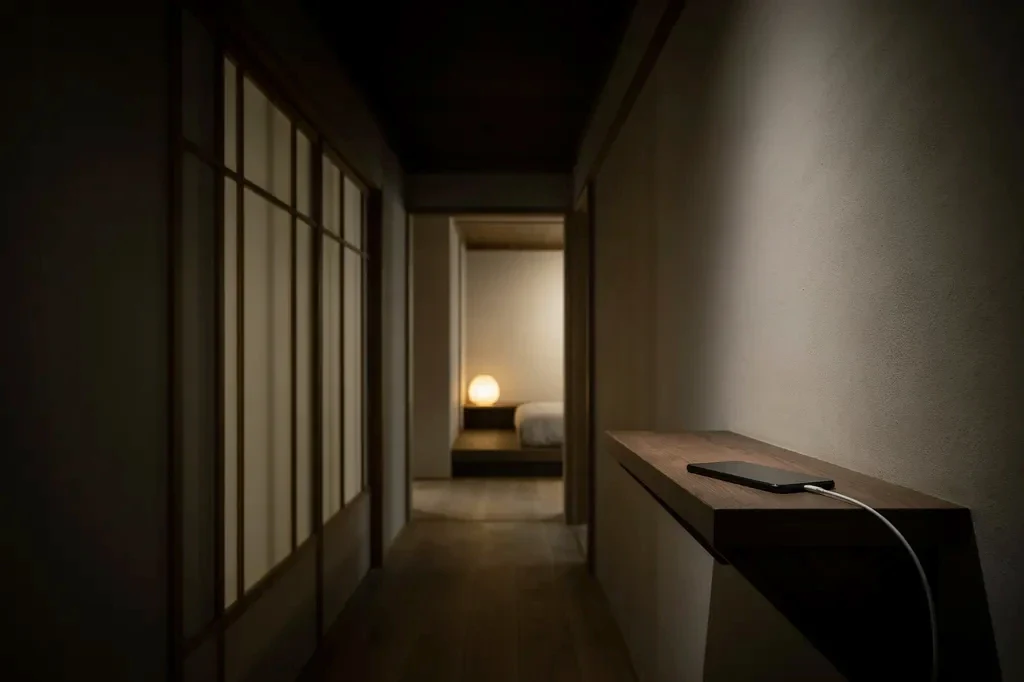
Charge the phone in the hall, the kitchen or anywhere you cannot reach from bed. If you use it as an alarm, a basic alarm clock costs very little and removes the main excuse.
Then set a phone curfew that matches your wind-down start, not an arbitrary hour. If your wind-down begins at 9:30, that is when the phone goes to its spot. Most phones have a downtime or focus setting that can quiet notifications from that time on, so the decision is made once rather than every evening.
This does not ban screens. You can still watch something in the living room. It just ends the last and worst part of the evening, the scroll in bed after the light is off.
Things to do before bed instead of your phone
- Read something slow. Paper or a dim e-ink reader. Our guide to books to read before bed has suggestions.
- Make something warm and caffeine-free. See our caffeine-free evening drinks.
- Write two lines for tomorrow. Putting the unfinished things on paper is the idea behind the worry window.
- Lie down and do a body scan. Our body scan guide takes about ten minutes.
- Lay out tomorrow. Clothes on the chair, bag by the door.
Pick one or two. The point is to have something ready for the moment your hand goes looking for the phone.
If you do use a screen
Keep it passive and across the room rather than interactive and close. Turn the brightness down and the color warm, knowing that a filter on its own did not change sleep in the 2021 study. And stop at a set time, not when you notice you are tired, because by then it is usually later than you think.
When phone use is a sign of something else
Sometimes the phone is not the cause but the response. If you reach for it because you cannot sleep, the problem is lying awake, and checking the screen keeps you there. Our guides to clock-watching and stimulus control cover what to do instead.
There is also a pattern sometimes called revenge bedtime procrastination: staying up on the phone because the late evening is the only time that feels like yours. A 2021 study of 355 university students in China linked heavier smartphone use with more bedtime procrastination. If that sounds familiar, the fix is less about the phone and more about finding a protected hour earlier in the evening.
Frequently asked questions
How long before bed should you stop using your phone? There is no tested magic number. Setting the phone aside when your wind-down starts, and keeping it out of the bedroom, matters more than an exact count of minutes.
Does night mode stop the phone affecting sleep? Not on its own. In a 2021 study of 167 young adults, sleep was no better with Night Shift on than with it off.
Is watching TV before bed as bad as a phone? Probably not. In a large US poll, interactive devices were linked to more trouble falling asleep, while passive screens like TV were not.
What can I do before bed instead of my phone? Read, make a warm caffeine-free drink, write a short note for tomorrow, do a body scan, or lay out the morning.
Can I use my phone as an alarm? You can, but it keeps the phone within reach. A basic alarm clock lets the phone sleep somewhere else.
The bottom line
Blue light is the part of the phone problem that gets the attention, and it is the smaller part. The bigger costs are the later lights-out and the busy mind. Put the phone to bed in another room when your wind-down starts, have something else ready to do, and let the evening end without it.
Sources
Retrieved November 2026.
- Chang AM, Aeschbach D, Duffy JF, Czeisler CA. Evening use of light-emitting eReaders negatively affects sleep, circadian timing, and next-morning alertness. PNAS. 2015;112(4):1232-1237. doi:10.1073/pnas.1418490112
- Duraccio KM, Zaugg KK, Blackburn RC, Jensen CD. Randomised trial of Night Shift on, off and no phone in adults aged 18 to 24 (title not retrieved). Sleep Health. 2021;7(4):478-484. doi:10.1016/j.sleh.2021.03.005
- Bauducco S, Pillion M, Bartel K, Reynolds C, Kahn M, Gradisar M. A bidirectional model of sleep and technology use. Sleep Med Rev. 2024;76:101933. doi:10.1016/j.smrv.2024.101933 (abstract)
- Exelmans L, Van den Bulck J. Bedtime mobile phone use and sleep in adults. Soc Sci Med. 2016;148:93-101. doi:10.1016/j.socscimed.2015.11.037 (cross-sectional)
- Gradisar M, et al. National Sleep Foundation 2011 Sleep in America poll analysis (title not retrieved). J Clin Sleep Med. 2013;9(12):1291-1299. doi:10.5664/jcsm.3272
- Geng Y, Gu J, Wang J, Zhang R. Smartphone addiction and depression, anxiety: the role of bedtime procrastination and self-control. J Affect Disord. 2021;293:415-421. doi:10.1016/j.jad.2021.06.062 (cross-sectional)
Educational only. This article is not medical advice, and nothing in it is a substitute for talking to a clinician about your own sleep.