Home / Journal / Shift Workers & Odd Hours
The Best Bedroom Temperature for Daytime Sleeping (And Why It's Different)
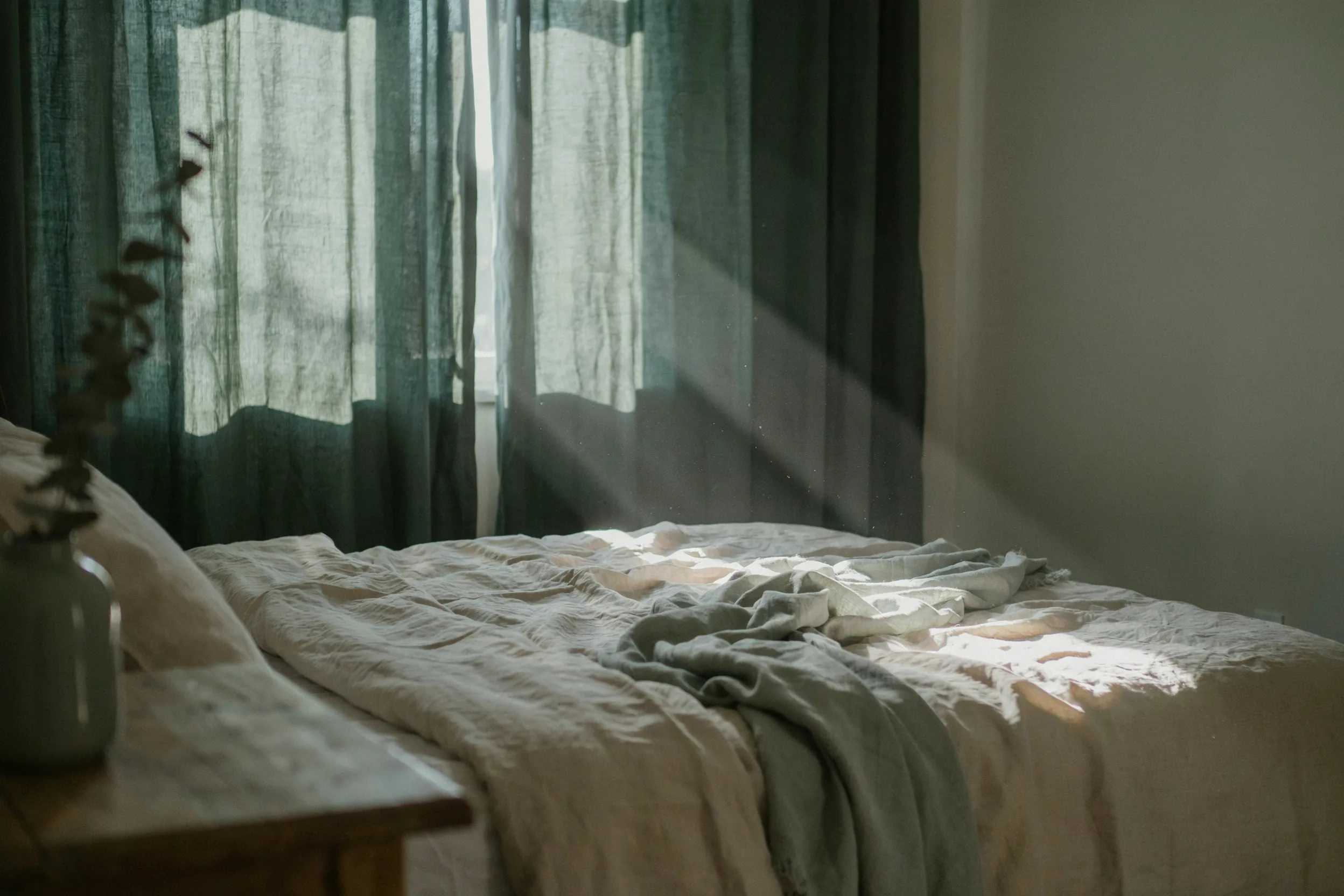
Nine in the morning, and the street outside is already warmer than the room you slept in the night before. If you work nights, this is not a metaphor. It's Tuesday. You've come home past the school run and the coffee line, drawn the curtains against a sun with no intention of setting for another twelve hours, and lain down to do the harder version of a task that is already hard: fall asleep while your body insists it is time to be awake.
Most bedroom-temperature advice was written for someone sleeping at night, in a house already cooling toward its daily low point. A daytime sleeper is working against the opposite slope. Understanding why is worth a few minutes, because it changes which fixes are worth trying and which ones just feel like they should work.
The circadian temperature problem, in plain terms
Human core body temperature runs its own roughly 24-hour cycle, set by the brain's circadian clock and largely independent of whatever the thermostat says. In people on an ordinary day-active schedule, that internal temperature bottoms out in the early morning hours, generally somewhere around 4 to 6 a.m., and reaches its high point in the evening, generally somewhere around 6 to 8 p.m. Sources differ slightly on the exact clock times, but the shape holds: low before dawn, high in the evening.
That falling edge, the hours before the daily low, is when the body is already primed for sleep. It's a large part of why bedtime works when it works. You lie down as your temperature is already heading downhill, and sleep rides that slope down with you.
A person sleeping during the day, unless their body clock has genuinely flipped after months on a fixed night schedule, which is uncommon even among long-term shift workers, is doing the opposite. Sleep from 8 a.m. to 4 p.m. usually means lying down while core temperature is still climbing, or sitting near its daily peak. The body is being asked to drop into sleep at the point in its own cycle when it is arguing hardest for wakefulness.
Why daytime heat fights sleep onset
Falling asleep isn't just a matter of feeling tired. It involves a physical event: the body sheds heat through the skin, especially the hands and feet, in a process researchers call distal vasodilation. Blood vessels near the surface open, heat radiates out, and core temperature drops by a small amount, usually less than a full degree Fahrenheit, in the run-up to sleep. Faster heat loss is associated with faster sleep onset.
That heat has somewhere to go only if the air around you is cooler than your skin. A warm room narrows that gradient. A daytime sleeper is often stacking two problems: a circadian rhythm that isn't cooperating, and a bedroom that, thanks to daylight and daytime heating patterns, tends to run warmer than a nighttime bedroom would at 2 a.m. Neither problem is large on its own. Together they make the small temperature drop sleep depends on harder to reach.
What the research actually supports, and what it doesn't
Here it's worth being honest about the limits of what's been studied. Despite a fair amount of searching, no research turned up a specific recommendation along the lines of "daytime sleepers should keep their room five degrees cooler than nighttime sleepers." That precise number doesn't appear to exist in the literature. Anyone stating it as established fact is going further than the evidence goes.
What does exist is more general, and still useful. Sleep Foundation, summarizing physician guidance, states that most doctors recommend a bedroom between 65 and 68 degrees Fahrenheit. CDC's National Institute for Occupational Safety and Health gives shift workers essentially the same range in its nurse fatigue training materials, alongside the standard trio of blackout shades, an eye mask if needed, and earplugs for a noisy daytime household. NIOSH doesn't treat daytime sleep as needing a colder number than nighttime sleep. It treats darkness and quiet as the parts of the environment needing the most deliberate work during the day, with cool as a background constant.
Separately, a systematic review of heat-exposed workers found that bedroom temperatures above roughly 25°C (77°F) were consistently linked to reduced sleep efficiency and delayed sleep onset, and named shift workers among the groups most exposed to this problem, largely because daytime indoor temperatures in un-cooled housing run higher than overnight ones do. That's a real finding, but it's about heat generally raising the bar against sleep, not a specific ideal daytime number.
Put together, the honest guidance is this: aim for the same 65 to 68 degree range everyone is told to aim for, and take the daytime heat problem seriously enough to actually solve it, rather than assuming a colder number is automatically the fix.
Cooling a room that daylight keeps warming
Block the sun before it becomes a problem. Blackout curtains matter for daytime sleep primarily because they stop light, but a window taking direct sun for hours can also measurably warm a room before you ever lie down. Closing heavy curtains or blinds in the morning, before the sun hits that side of the house, does more than closing them right before bed.
Set up an actual cross-breeze. A single fan aimed at the bed mostly moves warm air around. Two openings, one for air to enter and one to leave, with a fan pushing air through the room rather than just at your face, does more, especially if outside air is cooler than the room. Even when it isn't, moving air across skin still helps through evaporative cooling.
Choose bedding for breathability, not warmth. Linen and cotton percale move air and moisture away from the body better than heavier synthetic blends or high thread-count sateen, which trap heat against the skin. This matters more for daytime bedding, which is already fighting a warmer room.
A warm shower before bed helps more than a cool one, and the evidence is genuinely solid. This runs against instinct. A meta-analysis of 13 trials found that water-based passive heating, essentially a warm shower or bath at 104 to 108.5°F for as little as ten minutes, taken one to two hours before sleep, shortened time to fall asleep by about 36 percent in the studies reviewed. That's roughly a third off however long it usually takes to drop off, though most of the underlying trials were run on people sleeping at night, so the effect hasn't been directly tested in daytime sleepers. The mechanism is the same distal vasodilation described above: warm water opens blood vessels near the skin, and the heat loss as you cool back down helps pull core temperature onto the downward slope sleep needs. A cool shower might feel like the obvious move after a hot commute, and there's nothing wrong with taking one for comfort, but it isn't the version backed by this research.
The winter problem nobody mentions
It's tempting to file all of this under summer. It isn't only a summer problem. Homes often run warmer during the day in winter than overnight, between daytime heating schedules, sun through windows even in cold months, and general household activity while everyone else is up. A daytime sleeper's room in January can sit closer to 72 or 74 degrees than the recommended 65 to 68, simply because nobody adjusted the thermostat for a bedroom used at 10 a.m. instead of 10 p.m. Blackout curtains still block solar heating in winter, and turning the heat down in the sleeping room specifically helps just as much.
None of this is entirely new. Homes built for hot climates long before air conditioning, with deep-set windows and shutters closed against the middle of the day, were built by people organizing daily life around the heat rather than a clock. The instinct behind a daytime sleeper closing the curtains at 8 a.m. is an old one.
A short checklist
- Keep the target range at 65 to 68°F, the same range used for nighttime sleep, rather than assuming daytime needs something colder.
- Block direct sun on the bedroom window before it heats the room, not just before bed.
- Set up two points of airflow for a real cross-breeze, not one fan aimed at the pillow.
- Choose linen or cotton percale bedding over heavier synthetic blends.
- Take a warm shower or bath, not a cool one, one to two hours before daytime sleep if you're trying to speed up sleep onset.
- In winter, check the actual room temperature at your sleep time rather than assuming a cold month means a cool room.
Frequently Asked Questions
Do daytime sleepers need a colder room than nighttime sleepers? No study found in this research supports a specific colder target. The same 65 to 68°F range recommended for nighttime sleep is the best-supported number for daytime sleep too. The real daytime-specific task is fighting the heat a sunlit, occupied house accumulates by mid-morning, not choosing a lower thermostat number.
Does the body eventually adapt to sleeping in daylight hours? Partially, with time and consistency, but full adaptation is uncommon even after years of fixed night shifts, and it reverses quickly on days off. Most shift workers are sleeping at least somewhat against their circadian rhythm most of the time.
Is a fan enough on its own? A single fan helps through evaporative cooling even in a warm room, but it doesn't lower the room's actual temperature. Pairing it with blocked sun and a true cross-breeze, two openings rather than one, does more.
Should I take a cool shower instead of a warm one before daytime sleep? The research on speeding up sleep onset supports warm water, roughly 104 to 108.5°F, one to two hours before sleep, not cool water. A cool shower may feel more refreshing after a hot commute, which is reasonable, but it isn't the choice with evidence behind it for falling asleep faster.
Bottom Line
The clearest finding here is also the least dramatic one: daytime sleepers are working against a body clock that hasn't caught up to the schedule, and a house that tends to be warmer at the hours they need to sleep in it. Neither the folk wisdom of "sleep colder during the day" nor a specific number backing it turned up in the research. What did turn up was more ordinary and more useful: block the sun early, build a real cross-breeze, choose breathable bedding, and consider a warm shower before bed rather than a cool one. None of it is dramatic. Most of what genuinely helps sleep rarely is.
Sources
- Sleep Foundation. "The Best Temperature for Sleep." Reviewed by David Rosen, MD. Read it
- National Institute for Occupational Safety and Health (NIOSH), CDC. "Module 6: Improving Your Sleep and Alertness, Create a Good Sleep Environment." Work Hour Training for Nurses. Read it
- National Institute for Occupational Safety and Health (NIOSH), CDC. "Tips to Improve Your Sleep When Times Are Tough." NIOSH Science Bulletin, 2020. Read it
- "Human Body Temperature Circadian Rhythm in Health and Disease." IntechOpen, 2019. Read it
- Haghayegh, S., et al. "Before-bedtime passive body heating by warm shower or bath to improve sleep: A systematic review and meta-analysis." Sleep Medicine Reviews, 2019. Read it
- "Impacts of heat on sleep quality among heat-exposed workers: a systematic review." PMC, National Library of Medicine. Read it