Home / Journal / The Evening Hour
Dim Lights Before Bed: How Bright Your Evening Really Is
Sleep advice pictures an evening lit by one lamp in the corner, the rest of the room gone soft. Most of us have a different one. The ceiling light that went on at six is still on at half past ten, and the last thing we see before bed is our own face under two bright bulbs in the bathroom mirror.
In this piece
"Dim the lights" is good advice that usually stops there. This page answers the next question, how dim and how would you know, and ends with a room-by-room plan for tonight. It is the detailed version of the light dial in our night routine guide.
What lux means, in plain words
Lux measures how much light lands on a surface. One lux is roughly 0.09 foot-candles. A systematic review of light and sleep gives rough reference points: about 300 lux in a home living area, about 500 in an office, about 1,000 outdoors on an overcast day, over 100,000 in sunlight, and about 10 at twilight.
Indoor light is dim next to daylight, which makes it easy to assume a lit living room does not count. The research says it does.
What the research says about evening light
Ordinary room light. In a 2011 study of 116 healthy adults aged 18 to 30, ordinary room light below 200 lux in the hours before bed delayed the start of melatonin in almost every participant (99 percent) and shortened the night's melatonin by about 90 minutes compared with dim light under 3 lux. The room light ran through the 8 hours before bed, in a research unit, in a young group. But it was the kind of light most of us sit under every evening.
How little light it takes. A 2019 study in PNAS exposed 55 adults aged 18 to 30 to a range of evening light levels for five hours. As a group, about 25 lux was enough to halve the evening rise in melatonin. Light at 10, 30 and 50 lux pushed the apparent start of melatonin later by 22, 77 and 109 minutes. That is lamp-level light.
People differ, a lot. The same study found the most sensitive person reached that halfway point at 6 lux, and the least sensitive at 350 lux. That is about a fiftyfold range, in healthy young adults.
Real homes. A 2020 study in Scientific Reports recorded light near eye level in the homes of 59 adults aged 18 to 65 in Melbourne, then applied the lab sensitivity curves. In 48 percent of homes, evening light was predicted to cut melatonin by at least half for the average person. For the average home, the prediction ranged from 0 to 87 percent depending on who lived there. These are predictions, not measured melatonin. People also spent more time awake in the first 90 minutes in bed on evenings brighter than their own usual, an observational link rather than proof.
Ordinary indoor light is enough to matter, and you cannot tell from the outside how sensitive you are.
How bright should lights be before bed?
The closest thing to a target comes from a 2022 expert consensus published in PLOS Biology. Their evening target applies from at least three hours before bedtime, measured at the eye about 1.2 m (about 4 ft) from the floor, using a specialist measure that weights light by its effect on the body clock. In everyday terms, they note that evening light in homes is commonly around 30 lux at the eye, and that many ordinary warm white bulbs of 2,700 to 3,000 K meet the target at about that level. The bedroom should be as dark as possible.
That 30 does not contradict the 300 above, which is light on a surface like a table rather than light reaching your eyes. A working answer is roughly 30 lux of warm white light at eye level, which in practice means a lamp or two rather than the ceiling.
Can you measure it with your phone? Not reliably. A German lighting institute, DIAL, tested light-meter apps against a reference meter and found errors of up to 113 percent, with four identical iPhones giving very different readings. A Toronto poster study of 21 phone models reached the same conclusion. Neither is peer-reviewed, but they agree, and I would not trust an app to tell 30 lux from 100. Go by which lights are on instead.
Brightness first, color second
Color does matter. In a small 2011 lab study, 16 young men sat under 40 lux of light for two hours in the evening, and cool 6,500 K light suppressed melatonin more than warm 2,500 K light at the same brightness. A 2026 study that measured 52 household lamps estimated that cool white LEDs would suppress melatonin more than three times as much as warm white LEDs, a median of 12.3 percent against 3.6 percent. That was a calculation from the lamps' light, not a test in people. In the Melbourne homes, evenings lit mainly by LED or fluorescent light carried nearly double the body-clock-weighted light of incandescent evenings.
But the evidence on color at real home light levels is thin, one small trial and some modelling. The brightness evidence is broader and the effects larger. A warm bulb in a bright ceiling fitting is still a bright ceiling fitting. Dim first, then go warm.
Room by room
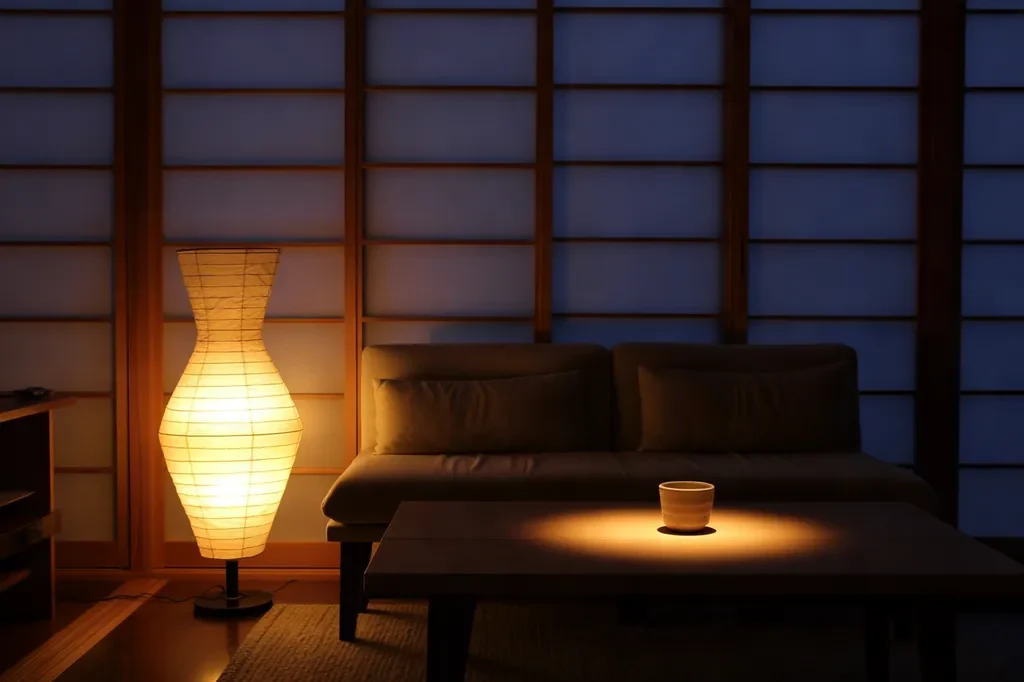
Living room. Ceiling light off by the start of your wind-down, lamps on. What counts is the light reaching your eyes, so shaded lamps beside you beat open bulbs in your line of sight.
Kitchen. Can be the brightest room, and the hardest to dim because you need to see what you are cutting. Cook under the full lights, then switch to an under-cabinet light or a single lamp for clearing up and the late drink.
Bathroom. The room most likely to undo the rest, because mirror lights sit at face height. Brush your teeth with the mirror light off and a dimmer light on, or with the door open to a lit hall. A low, warm plug-in light by the sink covers the last visit before bed.
Bedroom. One warm lamp for reading, switched off at lights-out, and the room as dark as you can make it after that. Blackout blinds help. For what to read, see books to read before bed.
The 3 a.m. trip. Do not switch on the main light. A low, warm night light at floor level in the hall and bathroom is enough to see by. The 2022 consensus allows light when you need to see at night, but recommends keeping it low.
Screens have their own page: putting the phone away before bed.
When to start dimming
The consensus target starts three hours before bed. That is a long stretch of lamplight, and it is easier in two steps. After the evening meal, swap the ceiling lights for lamps. When your wind-down starts, 60 to 90 minutes before lights-out, drop to the fewest and lowest lamps you can comfortably use. The night routine guide sets that time from your wake time.
Morning daylight is the other half of this, covered in our winter night routine.
Tonight's checklist
- Ceiling lights off by the wind-down.
- One or two lamps on, low and warm.
- Bathroom mirror light off for the last visit, or used briefly.
- A low, warm night light in the hall for the night trip.
- Bedroom dark at lights-out.
The printable checklist puts this alongside the other evening steps on one page.
Frequently asked questions
Should you dim lights before bed? Yes. Ordinary room light in the evening delays melatonin in lab studies. Lamps instead of ceiling lights is the simplest change.
How bright should lights be before bed? Around 30 lux of warm white light at eye level, roughly one or two lamps, can meet a 2022 expert consensus target. Some people are far more sensitive, so dimmer is safer.
What color light is best before bed? Warm white, around 2,700 to 3,000 K on the bulb box. Brightness matters more than color, so dim first.
Do warm light bulbs help you sleep? Probably a little, by cutting the part of light the body clock responds to most. The evidence at home light levels is limited, and a warm bulb at full brightness is still bright.
Is a night light bad for sleep? A bright one left on in the bedroom may be. Keep the bedroom dark and put a low, warm night light in the hall or bathroom instead.
The bottom line
Most evening light comes from the ceiling, and it is more than the body clock needs. Turn the overheads off, light the room with one or two low, warm lamps, and keep the bathroom and the 3 a.m. trip dim. You cannot measure your own sensitivity, so aim lower than feels necessary. Expect a modest difference, not a different night.
Sources
Retrieved November 2026.
- (Authors not retrieved.) A systematic review of the amount and timing of light in association with objective and subjective sleep outcomes in community-dwelling adults. Sleep Health. doi:10.1016/j.sleh.2018.09.006 (lux reference values are the review's approximations; foot-candle conversion uses its stated 0.0929 factor)
- Gooley JJ, Chamberlain K, Smith KA, Khalsa SBS, Rajaratnam SMW, Van Reen E, Zeitzer JM, Czeisler CA, Lockley SW. Exposure to room light before bedtime suppresses melatonin onset and shortens melatonin duration in humans. J Clin Endocrinol Metab. 2011;96(3):E463-E472. doi:10.1210/jc.2010-2098 (abstract)
- Phillips AJK, Vidafar P, Burns AC, McGlashan EM, Anderson C, Rajaratnam SMW, Lockley SW, Cain SW. High sensitivity and interindividual variability in the response of the human circadian system to evening light. PNAS. 2019;116(24):12019-12024. doi:10.1073/pnas.1901824116 (abstract)
- Cain SW, McGlashan EM, Vidafar P, Mustafovska J, Curran SPN, Wang X, Mohamed A, Kalavally V, Phillips AJK. Evening home lighting adversely impacts the circadian system and sleep. Sci Rep. 2020;10:19110. doi:10.1038/s41598-020-75622-4 (observational; melatonin effects are modelled predictions)
- Brown TM, Brainard GC, Cajochen C, Czeisler CA, Hanifin JP, Lockley SW, et al. Recommendations for daytime, evening, and nighttime indoor light exposure to best support physiology, sleep, and wakefulness in healthy adults. PLoS Biol. 2022;20(3):e3001571. doi:10.1371/journal.pbio.3001571 (expert consensus)
- Chellappa SL, Steiner R, Blattner P, Oelhafen P, Götz T, Cajochen C. Non-visual effects of light on melatonin, alertness and cognitive performance: can blue-enriched light keep us alert? PLoS One. 2011;6(1):e16429. doi:10.1371/journal.pone.0016429 (abstract)
- Terán E, Yee-Rendon CM, Sosa-Arámbula HJ, De La Herrán-Arita AK, Woods RL. Home lighting, blue-light filtering, and their effects on melatonin suppression. Sci Rep. 2026;16:2850. doi:10.1038/s41598-025-29882-7 (abstract; lamp measurements and modelled estimates, no participants)
- DIAL. Luxmeter app vs. measuring device. dial.de (industry test, not peer-reviewed)
- Messalam R, Abdoli-Eramaki M. Smartphone illumination apps (title not retrieved). Ryerson University, 2018 poster. torontomu.ca (poster, not peer-reviewed)
Educational only. This article is not medical advice, and nothing in it is a substitute for talking to a clinician about your own sleep.