Home / Journal / Sleep Guides
Sleeping Hot Next to Someone Who Sleeps Cold
One of you is lying on top of the covers with a foot out for air. The other is under the duvet and a blanket, asking whether the window really needs to be open.
In this piece
If you're a hot and cold sleeper couple, the fix that solves most of it is simple: two separate duvets on one bed, each chosen for the person underneath it. The argument about the thermostat can mostly stop there. The rest of this guide lists other options in order of cost, from free to expensive, so you can stop at whichever one works.
It's also worth knowing that night heat becomes more common from your 40s, especially around perimenopause. If one of you has started running much warmer than before, our guide to why you sleep hot after 40 explains why.
The Fix That Solves Most of It: Two Duvets
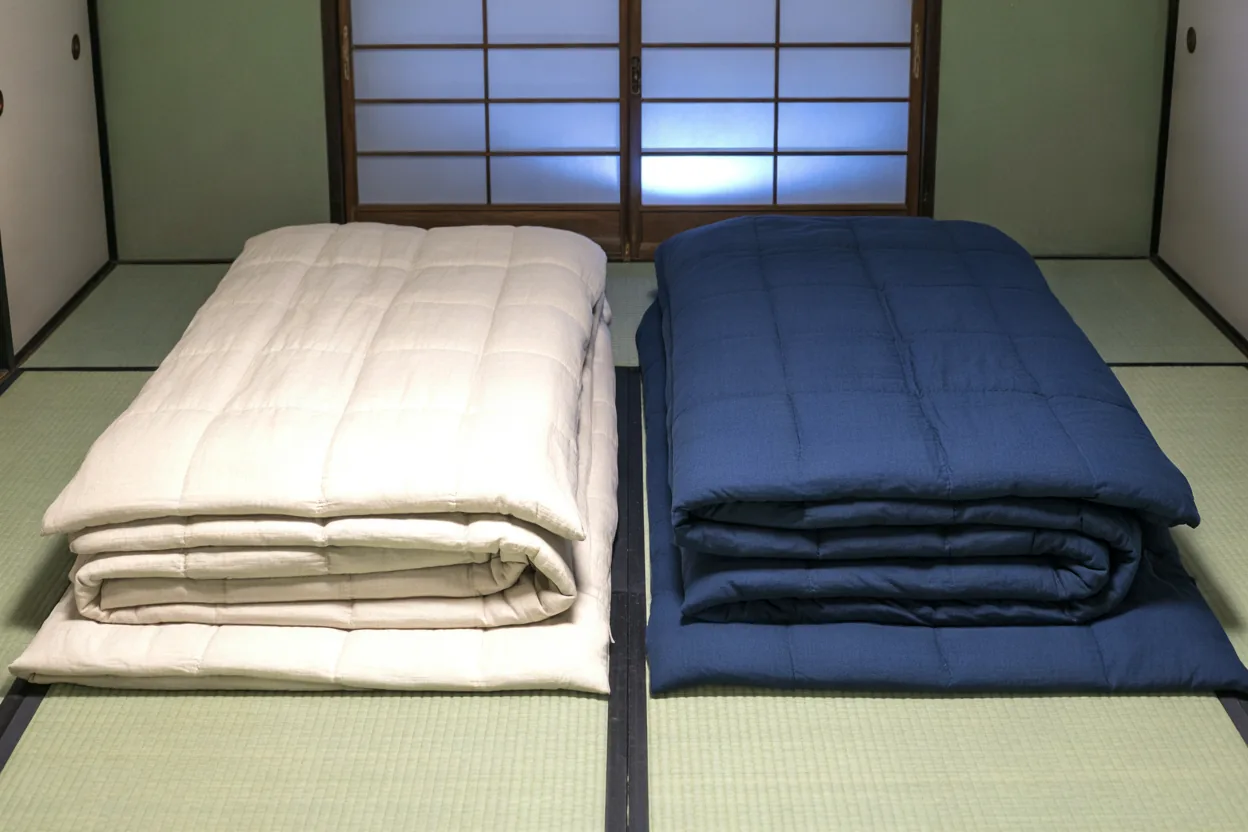
Instead of one large duvet, each of you has your own single duvet on the same bed. The hot sleeper picks something light, the cold sleeper something warm, and neither steals the covers.
This is often called the Scandinavian sleep method, after a custom said to be common in Nordic homes. We couldn't find a reliable source on where the name comes from, and it doesn't matter much. The idea works on its own logic: two people with different needs, two layers.
The good:
- Each person controls their own warmth.
- No more tug-of-war over the covers.
- One person's tossing and turning moves their own duvet, not both.
The trade-offs:
- The bed can look less tidy. A single flat sheet or a throw across the foot of the bed helps it look intentional.
- Some couples miss the feeling of being under the same cover. You can still share one when you want to.
- If you already own a large duvet, two singles are a new expense.
Free Changes
These cost nothing and are worth trying first.
- Swap sides. Put the hot sleeper nearest the window, door or fan, and the cold sleeper on the side away from drafts.
- Layer only the cold side. Fold a blanket over half the bed so it covers only the cold sleeper.
- Warm the cold sleeper locally. Socks, warm sleepwear, or a hot water bottle on the cold side, rather than heating the whole room.
If you use a hot water bottle, follow basic safety advice. Swansea Bay University Health Board in Wales advises using boiled water that has cooled for a few minutes, always using a cover, never lying or sitting on a filled bottle, checking it for wear before each use, and replacing it every two years.
Bedding That Splits the Difference
If you already have two duvets, or want to go further:
- Different weights per side. A light summer-weight duvet for the hot sleeper and a heavier one for the cold sleeper.
- Different fabrics per side. Breathable cotton percale or linen on the hot side, and something cozier like flannel on the cold side. Our guide to which sheet fabric sleeps coolest explains which fabrics sleep coolest.
- Different sleepwear. Often the cheapest bedding change of all.
Bigger Spends
If the cheaper fixes don't settle it, there are products built for exactly this problem. They're worth considering only after you've tried separate duvets.
- Dual-zone heated mattress pads let each side set its own warmth, which suits a cold sleeper well.
- Split toppers put a different topper on each half of the bed.
- Bed cooling systems circulate air or water through a pad or cover to cool one side. They're the most expensive option.
The Thermostat Compromise
When you share a room, set it for the hot sleeper and warm the cold sleeper locally. It's easier to add a layer than to cool someone down, and a cooler room tends to suit sleep better anyway. Our guide to the best bedroom temperature has the research-backed range, and natural sleep aids without pills covers the rest of the evening environment.
When Temperature Isn't the Real Issue
Sometimes the temperature argument is covering something else. Snoring, different bedtimes, a partner who moves a lot, or one person reading late can all make sharing a bed harder.
Sharing a bed does change how you sleep. A 2026 systematic review in Sleep Health found evidence of partner disturbance in all four studies that looked for it. A 2020 sleep-lab study of young couples found that sleeping together was linked to about 10% more REM sleep and more synchronized sleep stages between partners, along with more limb movements. So there are costs and benefits, and they vary from couple to couple.
If snoring is part of the picture, it's worth taking seriously. Loud snoring with gasping or pauses in breathing can be a sign of sleep apnea, which is also linked to night sweats. Our guide to why you sleep hot after 40 covers when to see a doctor.
Sleeping apart is more common than you might think. In a 2023 survey of 2,005 US adults by the American Academy of Sleep Medicine, 20% said they occasionally sleep in another room to accommodate a bed partner, and 15% said they do so consistently. A spokesperson for the Academy noted that people who are sleep deprived are more likely to argue with their partners. Separate rooms on some nights, or every night, can be a practical choice rather than a sign that something is wrong.
Frequently Asked Questions
What is the Scandinavian sleep method? Sharing a bed but using two separate single duvets, so each person controls their own warmth. It's one of the simplest fixes for a hot and cold sleeper couple.
What temperature should the bedroom be for a couple? Set it for the hotter sleeper and let the colder one add layers, since warming one person is easier than cooling one. Our bedroom temperature guide has the research-backed range.
Are dual-zone mattress pads worth it? They can end the argument, but they're a big spend. Try separate duvets, different bedding weights and swapping sides first.
Why does my partner sleep so hot? Age, hormones, alcohol, late meals and some medications can all play a part. Frequent drenching night sweats are worth a doctor's visit.
Is sleeping in separate beds bad for a relationship? Not necessarily. In a 2023 American Academy of Sleep Medicine survey of US adults, more than a third said they sleep in another room at least occasionally to accommodate a partner. Sharing a bed has some benefits for sleep and some costs, so the right arrangement depends on the couple.
The Bottom Line
Start with two duvets. Then swap sides, layer the cold side, and set the room for the hot sleeper. Spend money only if those don't work. And if temperature is only part of the problem, it's fine to talk about the rest, including sleeping apart some nights. A rested couple tends to be a kinder one.
Sources
Retrieved October 2026.
- Swansea Bay University Health Board (NHS Wales). Burns patients' stark warning about the potential dangers of hot water bottles. 18 October 2022. sbuhb.nhs.wales
- Rayward L, Green D, Little JP. Partner disturbance in co-sleeping and effects on sleep architecture: a systematic review. Sleep Health. 2026;12(2):366-379. doi:10.1016/j.sleh.2026.01.003 (abstract via PubMed. One author affiliated with a mattress manufacturer.)
- Drews HJ, et al. Bed-sharing in couples is associated with increased and stabilized REM sleep and sleep-stage synchronization. Front Psychiatry. 2020;11:583. doi:10.3389/fpsyt.2020.00583 (abstract via PubMed)
- UPI (HealthDay). A third of American couples choose "sleep divorce" for more restful slumber. 13 July 2023. upi.com (report of the American Academy of Sleep Medicine survey)
Educational only. This article is not medical advice, and nothing in it is a substitute for talking to a clinician about your own sleep. Last reviewed October 2026.