Home / Journal / Natural Aids
Ashwagandha and Sleep: Morning vs Night Dosing Explained
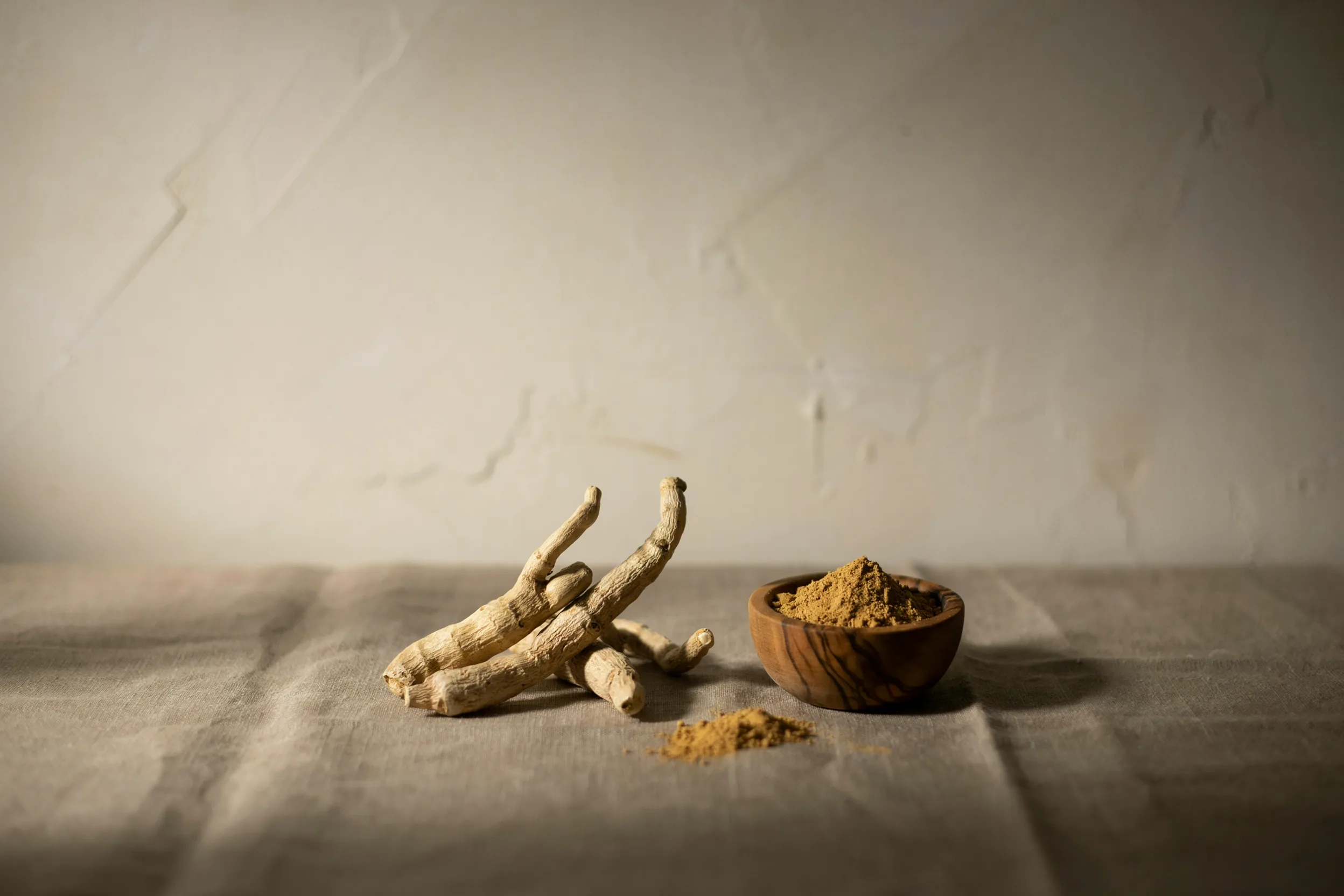
Some remedies work like a switch and some work like a season. Ashwagandha is a season. The root has been used in Ayurvedic practice for a very long time as a restorative taken steadily rather than a sedative taken at need, and the modern research, whatever else it says, agrees on that one point: nothing about ashwagandha happens tonight.
Which makes the morning-versus-night question less urgent than it sounds, and more interesting.
Some links below are affiliate links. If you buy through one we earn a small commission, at no extra cost to you. It doesn't change what we recommend.
What ashwagandha actually does
Ashwagandha is an adaptogen. Instead of sedating you directly, it works on the stress system itself, the hypothalamic-pituitary-adrenal axis that decides how hard your body idles. Trials in stressed adults have found reductions in cortisol and perceived stress over weeks of use, and a 2021 meta-analysis pooling five randomized trials found a small but significant improvement in sleep, most pronounced in people with diagnosed insomnia, at doses of 600 mg per day, taken for eight weeks or longer.
Read that sentence again slowly, because all three conditions matter: real sleep trouble, a full dose, and a commitment measured in months. Ashwagandha rewards the patient and quietly ignores the curious.
Morning or night: the honest answer
No trial has put morning dosing head-to-head against night dosing. What the trials actually did is instructive, though. The best-known insomnia study gave 300 mg of a standardized root extract twice daily, morning and evening, and found improvements in how quickly people fell asleep and how efficiently they slept. Most stress trials split the dose the same way.
So the evidence-backed default is both. From there, the practical logic:
- Take it at night if sleep is your main goal, or if it makes you at all drowsy. It isn't a knockout drop, but its calming lean fits the evening.
- Take it in the morning, with food, if it unsettles your stomach on its own, or if daytime stress is the thing you're actually treating.
- Split it if you're taking 600 mg and want steady coverage.
The unglamorous truth: consistency beats clock time. An adaptogen taken daily at a mediocre hour outperforms one taken perfectly and occasionally.
The specifics
- Dose: 300 to 600 mg per day of a standardized root extract. KSM-66 is the most-studied root-only extract, while Sensoril is a more concentrated root-and-leaf extract typically dosed lower.
- With food: yes, especially at first.
- Runway: four to twelve weeks. Judge it at the two-month mark, not the two-day mark.
- Stacking: pairs sensibly with magnesium glycinate or the theanine-glycine stack, which work through different, faster mechanisms.
Who should skip it, or ask first
This list is longer than chamomile's, and worth taking seriously:
- Pregnant or nursing: skip it entirely.
- Thyroid conditions or thyroid medication: ashwagandha can nudge thyroid hormone levels upward. Ask before starting, and monitor if you do.
- Autoimmune conditions or immunosuppressants: its mild immune-stimulating activity argues for a conversation first.
- Sedative medications: effects can add together.
- Liver: injury is rare but documented. Stop and see a doctor if you notice yellowing skin or eyes, dark urine, or unusual fatigue.
The long-term picture has lately improved: the longest safety study to date followed healthy adults taking 600 mg daily for a full year and found no ill effects on liver, kidney, or thyroid measures. It was observational and in healthy people, though, so if ashwagandha becomes a fixture, mention it at your next appointment, especially if any condition above applies.
FAQ
Will I feel it the first night?
Almost certainly not, and a first-night effect would more likely be expectation than pharmacology. The measured changes in trials built over four to twelve weeks.
Should I cycle it or take breaks?
Some people take planned breaks after a few months. A year-long safety study in healthy adults found no organ-level trouble at 600 mg daily, which softens the old worry, but pausing periodically to ask whether it's still earning its place remains a good habit.
KSM-66 or Sensoril?
Both have trial support. KSM-66 is the root-only workhorse most sleep and stress studies used. Sensoril is more concentrated and often described as the calmer of the two. Choosing either beats agonizing between them.
The bottom line
Ashwagandha doesn't put you to sleep; it lowers the water level your stress floats on, slowly, over weeks. Take it morning and evening the way the trials did, or pick the hour you'll actually keep, and let the season do its work. The root's oldest lesson is the one the studies keep confirming: what restores you is rarely what's fastest.
Sources
The trial findings, dosing, and cautions on this page trace back to these.
- National Institutes of Health, Office of Dietary Supplements. "Ashwagandha: Is it helpful for stress, anxiety, or sleep?" Read it
- Langade D, Kanchi S, Salve J, Debnath K, Ambegaokar D. "Efficacy and Safety of Ashwagandha (Withania somnifera) Root Extract in Insomnia and Anxiety: A Double-blind, Randomized, Placebo-controlled Study." Cureus 11(9):e5797 (2019). Read it
- Cheah KL, Norhayati MN, Husniati Yaacob L, Abdul Rahman R. "Effect of Ashwagandha (Withania somnifera) extract on sleep: A systematic review and meta-analysis." PLOS ONE (2021). Read it
- Salve J, Kale S, Prajapati BL, et al. "Safety of 12-Months Administration of Ashwagandha (Withania somnifera) Standardized Root Extract in Healthy Adults: A Prospective, Observational Study." Phytotherapy Research (2025). Read it
Educational only, not medical advice. If sleep loss is affecting your health or safety, speak with a clinician.
Some links on the guides we point you to may be affiliate links; if you buy through one, Cricket & Moon may earn a small commission at no extra cost to you.