Home / Journal / Natural Aids
Warm Milk Before Bed: Is There Anything to It?
A glass of warm milk before bed is one of the oldest sleep remedies there is. The usual explanation is tryptophan, and that part doesn't hold up well. There isn't enough of it in a glass of milk, delivered the right way, to make you sleepy on its own.
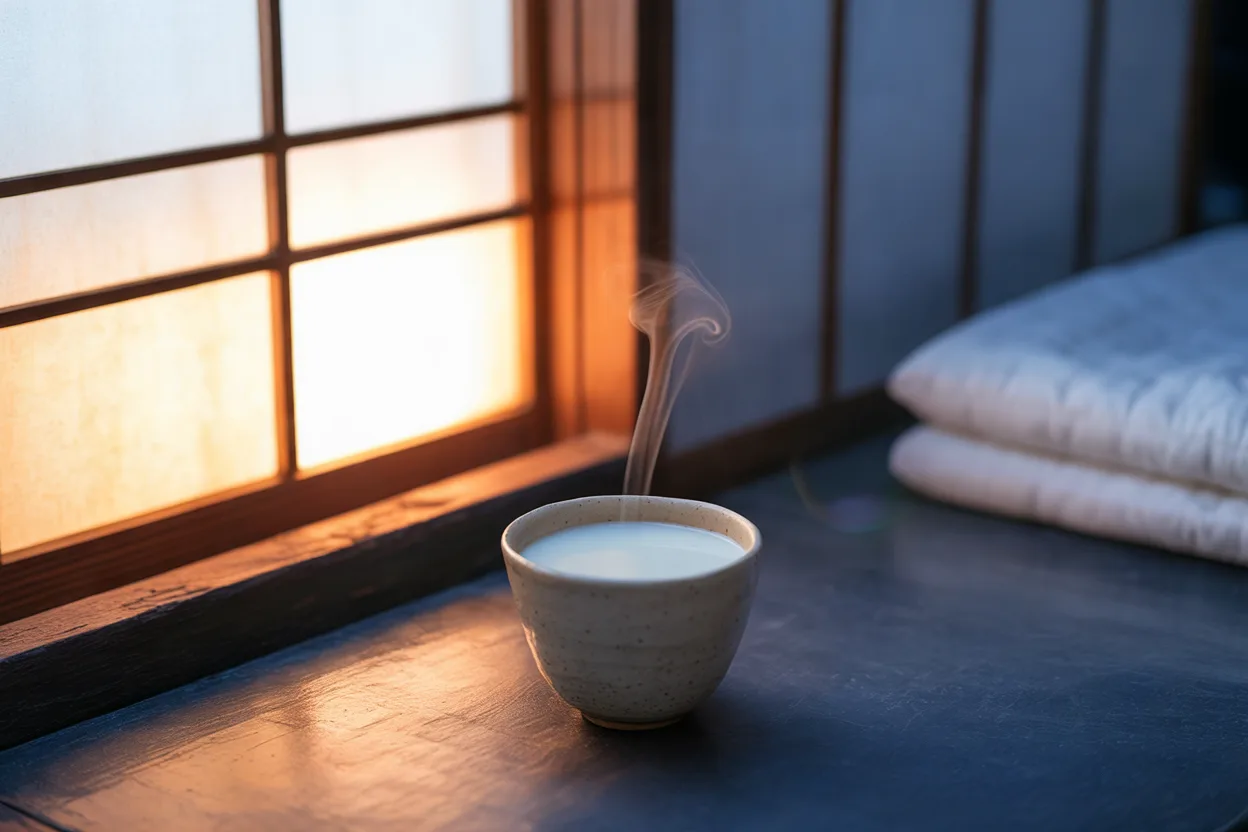
The ritual is another matter. A warm drink at the same time each night, swapped in for a late coffee or a nightcap, can help you wind down. And there is some newer research on milk and sleep, though it isn't quite about the drink your grandmother made.
The Short Answer
- Tryptophan is real, but the amount in a glass of milk, mixed in with milk's other proteins, is unlikely to change much in your brain.
- Studies of milk and sleep exist. Most test special products, such as fortified milk, fermented milk, or isolated milk proteins, rather than a plain glass. The benefits they report are small.
- The likelier helpers are the ritual, the warmth, and what the milk replaces.
Where the Warm Milk Idea Comes From
Warm milk at night turns up across many traditions. In India, haldi doodh, warm milk with turmeric, has been a pre-bedtime drink for centuries. In Ayurveda, warm spiced milk is part of a broader approach to the evening, which we cover in Ayurvedic bedtime drinks for vata, pitta and kapha. In much of Europe and North America it's simply what you were given as a child when you couldn't sleep.
That last point is worth keeping in mind. A mouse study on "night milk" in the Journal of Medicinal Food noted that milk's reputation for sleep has long been attributed partly to psychological associations, the memory of being given milk at bedtime. For many people, the cup carries a feeling with it. That counts for something.
What the Research Says
The Tryptophan Problem
Tryptophan is an amino acid the body uses to make serotonin, which in turn is used to make melatonin. That chain is real. The problem is getting tryptophan from a glass of milk into the brain in useful amounts.
Tryptophan competes with other amino acids to cross into the brain. What matters is not how much tryptophan you eat, but how much there is compared with those competitors. Milk contains plenty of both.
A small 2013 study in Clinical Nutrition shows how hard this is to shift with food. Six fasting men drank 40 grams (1.4 oz) of one purified milk protein, alpha-lactalbumin, which is unusually rich in tryptophan. Their blood tryptophan rose threefold, but the ratio that predicts brain uptake rose by only 50%.
For scale, a whole 240 ml (8 fl oz) glass of whole milk contains about 8 grams (0.3 oz) of protein in total, of all kinds. That study used five times that amount of a single, specially selected protein. A glass of milk is nowhere near it.
What Milk Studies Actually Test
Two recent meta-analyses looked at milk and sleep:
- A 2025 meta-analysis in Cureus pooled four clinical trials and found that milk and dairy products improved scores on the Pittsburgh Sleep Quality Index. The scores were self-reported, and the authors called for higher-quality studies.
- A larger 2026 meta-analysis in Nutrition Reviews combined 11 trials of milk-derived bioactives and fortified or fermented milk products. They improved sleep efficiency, meaning the share of time in bed spent asleep. In generally healthy people, they shortened the time it took to fall asleep by about 2 minutes. Only the milk protein and peptide products significantly improved sleep efficiency.
Two minutes is a small effect, and these were mostly special products, not a plain mug of warm milk. Still, it's honest to say milk isn't nothing. Some milk-based products show modest benefits in trials.
"Night Milk" and Melatonin
Cows' milk collected at night contains more melatonin than milk collected during the day, and some products are made from it. The research is thin for adults. A 2019 review in the Journal of Food Science concluded that milk and sour cherries, as food sources of melatonin, may improve sleep quality, but noted inconsistent doses and durations across studies. The "night milk" study above was in mice. Ordinary supermarket milk isn't night milk, so this doesn't change much for a glass at home.
Why a Warm Drink Still Helps
It's a wind-down cue. Making the same drink at the same time each night tells your body something about what's coming. That's the principle behind stimulus control, a core part of cognitive behavioral therapy for insomnia. Our guide to stimulus control for insomnia explains how cues like this work.
It replaces something worse. Warm milk often takes the place of a late coffee, a strong tea or a nightcap. That swap may matter more than anything in the cup.
Warmth fits the evening. Getting warm before bed can help your body cool down afterward, which is part of falling asleep. Most of the research here is on warm baths rather than drinks, so don't expect a cup to do what a bath does.
Cold milk works too. The nutrients are the same whether it's warm or cold. Warmth just makes it more of a ritual.
Making It Work for You
- Keep it small. About a cup, around 240 ml (8 fl oz). A big drink close to bed is likely to wake you later for the bathroom.
- Time it. Roughly 30 to 60 minutes before bed.
- Make it plain, or golden. Plain warm milk is fine. For more flavor, try our evening golden milk recipe, made the same caffeine-free way.
- Dairy-free? Warm oat or soy milk keeps the ritual. They contain different proteins, so the milk-specific research above doesn't apply to them, which matters less than it sounds given how small those effects are.
- Who should skip it. If you're lactose intolerant, a bedtime glass may cause discomfort, so choose a lactose-free or plant milk. Some people find milk close to bedtime aggravates reflux. If that's you, have it earlier or try something else.
Other caffeine-free options: chamomile tea before bed, tart cherry juice, or the list in cozy caffeine-free drinks for the evening.
Frequently Asked Questions
Does warm milk really help you sleep? Not through tryptophan alone. A glass doesn't contain enough, relative to milk's other proteins, to change much in the brain. The warm, familiar ritual and skipping caffeine or alcohol are the likelier reasons it helps.
Is cold milk as good as warm milk before bed? The nutrients are the same. Warmth adds comfort and makes it more of a ritual, which is most of the benefit.
How much tryptophan is in a glass of milk? Some, as part of about 8 grams of total protein in a 240 ml (8 fl oz) glass. The issue is that milk's other amino acids compete with tryptophan to reach the brain, so the amount in a glass is unlikely to make you sleepy.
Is milk before bed bad for reflux? Some people find it makes reflux worse when they drink it close to lying down. If that happens to you, have it earlier in the evening or choose a different drink.
What can I drink instead of milk before bed? Chamomile tea, golden milk made with oat milk, tart cherry juice, or any caffeine-free herbal infusion. Keep it small and have it at the same time each night.
The Bottom Line
Warm milk won't knock you out, and the tryptophan story is mostly a myth. Some milk-based products show small benefits in trials, but a plain glass isn't what was tested. What a warm drink does well is mark the end of the day. Keep it small, keep it caffeine-free, and let the ritual do the work. For more on why sleep remedies often promise more than they deliver, see common myths about natural sleep aids.
Sources
Retrieved October 2026.
- Fernstrom JD, et al. The ingestion of different dietary proteins by humans induces large changes in the plasma tryptophan ratio, a predictor of brain tryptophan uptake and serotonin synthesis. Clin Nutr. 2013;32(6):1073-6. doi:10.1016/j.clnu.2012.11.027 (abstract, via PubMed)
- Peres AP, et al. The consumption of milk or dairy products and sleep quality: a systematic review and meta-analysis. Cureus. 2025;17(9):e92556. doi:10.7759/cureus.92556 (abstract, via PubMed)
- Yu L, Li S, Kim JE. The impact of milk-derived bioactives and fortified or fermented milk products on sleep quality: a systematic review and meta-analysis. Nutr Rev. 2026. doi:10.1093/nutrit/nuag118 (abstract, via PubMed)
- Pereira N, et al. Influence of dietary sources of melatonin on sleep quality: a review. J Food Sci. 2020;85(1):5-13 (published online 2019). doi:10.1111/1750-3841.14952 (abstract, via PubMed)
- dela Peña IJI, et al. Milk collected at night induces sedative and anxiolytic-like effects and augments pentobarbital-induced sleeping behavior in mice. J Med Food. 2015;18(11):1255-61. doi:10.1089/jmf.2015.3448 (abstract, via PubMed)
- Sivasubramanian S. The secret history of the turmeric latte. SBS Food. 2016. sbs.com.au
- USDA FoodData Central, whole milk, as listed by FatSecret: 3.32 g protein per 100 ml. fatsecret.com (used to derive the per-glass protein figure)
Educational only. This article is not medical advice, and nothing in it is a substitute for talking to a clinician about your own sleep.